







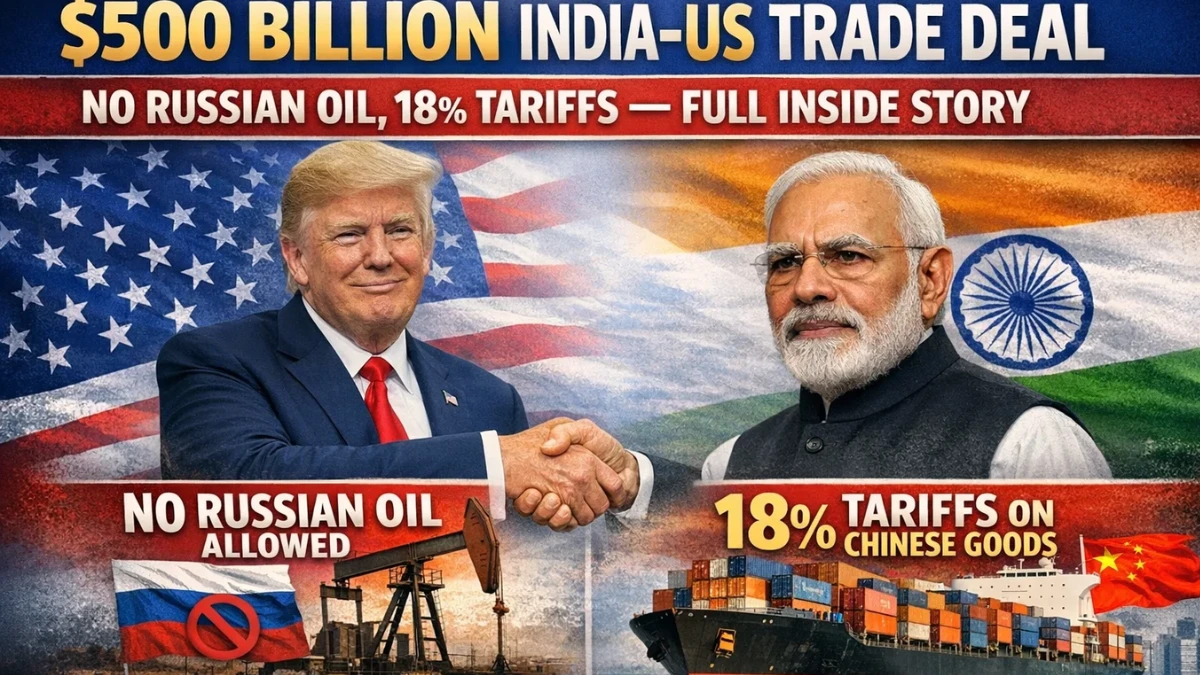
US Trade: A Trade Deal That Redefined Global Economics
The global economic landscape witnessed a historic turning point when India and the United States unveiled a $500 billion trade understanding that reshaped not just bilateral commerce, but global geopolitics. This deal — anchored around 18% tariffs, a controversial exit from Russian oil, and unprecedented market access — is being seen as one of the most powerful strategic trade realignments of the decade.
Unlike routine trade agreements, this deal blends economics, diplomacy, energy security, and global power politics into a single framework. For India, it promises massive export growth and deeper access to the world’s largest consumer market. For the U.S., it strengthens economic influence in Asia while countering rival energy and trade blocs.
This article explains the complete inside story — why the deal happened, what it really contains, who benefits, who loses, and how it could change India’s economic future.
1. Background: Why the India–US Trade Relationship Reached a Breaking Point
1.1 Rapid Growth, Rising Friction
Over the last decade, India–US trade expanded rapidly across IT services, pharmaceuticals, engineering goods, textiles, and electronics. However, growth came with friction:
- Trade imbalances widened
- Market access disputes intensified
- Tariff disagreements escalated
- Geopolitical differences surfaced
The situation worsened when the U.S. imposed steep reciprocal tariffs, citing trade fairness and strategic concerns.
1.2 Russian Oil: The Trigger Point
India’s increased purchase of discounted Russian crude oil after global sanctions became a central flashpoint. From the U.S. perspective, these purchases indirectly weakened sanctions pressure. From India’s view, affordable energy was critical for inflation control and economic stability.
This clash of priorities pushed trade relations to a crisis level.
2. The Tariff Shock: From 50% to 18%
2.1 How Tariffs Reached Punitive Levels
At the peak of trade tensions, Indian exports faced tariffs as high as 50%, including:
- Base reciprocal tariffs
- Additional penalty duties
- Strategic compliance tariffs
These measures severely impacted Indian exporters, particularly in manufacturing and MSME sectors.
2.2 The Breakthrough: 18% Tariff Framework
Under the new deal:
✔ U.S. tariffs on Indian goods were reduced to 18%
✔ Penalty tariffs linked to Russian oil were withdrawn
✔ Sector-specific tariff relief is under negotiation
Though not zero-duty access, this reduction restores global competitiveness for Indian products.
3. The $500 Billion Question: What Does India Commit To?
3.1 Understanding the $500 Billion Figure
The headline number — $500 billion — represents cumulative trade expansion expectations over multiple years, not a single-year transaction.
Key areas include:
- Energy imports
- Defense and aerospace
- Advanced technology
- Agricultural commodities
- Industrial machinery
3.2 Strategic Intent vs Legal Obligation
Importantly:
- The deal is framework-based, not a rigid contract
- Purchase volumes depend on market demand
- No immediate fiscal burden is imposed
This gives India flexibility while signaling long-term intent.
4. The Most Controversial Clause: No Russian Oil
4.1 What “No Russian Oil” Really Means
The deal does not mean an overnight ban. Instead:
- Gradual reduction of Russian crude imports
- Shift toward diversified energy sources
- Increased sourcing from U.S., Middle East, and Latin America
4.2 Economic Impact on India
Pros:
✔ Reduced geopolitical risk
✔ Stronger strategic alignment
✔ Stable trade relations
Cons:
⚠ Higher energy costs
⚠ Pressure on refinery margins
⚠ Possible fuel price volatility
Energy transition will be gradual, not abrupt.
5. Sector-Wise Impact Analysis
5.1 Manufacturing & Engineering (High CPC Sector)
Major beneficiaries:
- Auto components
- Heavy machinery
- Industrial equipment
- Electrical goods
Lower tariffs restore price competitiveness in U.S. markets.
5.2 Textiles & Apparel
- Tariff relief revives export demand
- Boosts employment-intensive sectors
- Strengthens India’s position against Asian competitors
5.3 Pharmaceuticals & Healthcare
India’s pharma exports gain:
- Easier regulatory cooperation
- Reduced trade friction
- Expanded generic drug access
High-CPC keywords like healthcare exports, pharmaceutical trade, medical supply chain make this sector crucial.
5.4 IT & Digital Services

Although services face fewer tariffs:
- Trade stability improves outsourcing confidence
- Strengthens tech partnerships
- Encourages cross-border innovation
5.5 Agriculture & Food Processing
Potential challenges:
- Increased competition from U.S. farm goods
- Pressure on domestic producers
- Need for protective safeguards
Balanced policy will be essential.
6. Financial Markets Reaction
6.1 Stock Market Impact
Markets responded positively due to:
- Reduced trade uncertainty
- Export-led growth expectations
- Improved investor confidence
Export-heavy sectors saw immediate momentum.
6.2 Currency & Capital Flows
- Strengthened rupee outlook
- Improved foreign investment sentiment
- Lower trade risk premium
7. Geopolitical Consequences
7.1 India–Russia Relations
While trade shifts may cool energy ties:
- Defense and diplomatic cooperation continues
- India maintains strategic autonomy
- No complete disengagement expected
7.2 India’s Global Positioning
The deal positions India as:
✔ A reliable global manufacturing hub
✔ A strategic U.S. economic partner
✔ A key player in global supply chain realignment
8. Critics vs Supporters: The National Debate
Supporters Say:
✔ Boosts exports
✔ Strengthens economy
✔ Reduces trade shocks
✔ Enhances global standing
Critics Argue:
⚠ Energy costs may rise
⚠ Domestic sectors face competition
⚠ Strategic independence could be pressured
The truth lies in execution and balance.
9. What Happens Next? Implementation Roadmap
Key upcoming steps:
- Sector-specific negotiations
- Energy transition planning
- Tariff-line clarification
- Regulatory harmonization
Success depends on policy discipline and diplomacy.
10. Long-Term Economic Outlook
If implemented effectively, the deal could:
- Add sustained export growth
- Strengthen manufacturing GDP share
- Attract long-term foreign investment
- Stabilize trade relations
This could define India’s economic trajectory for the next decade.
Also Read: India Post GDS 2026 Recruitment: Apply Now for BPM, ABPM & Dak Sevak Posts
Conclusion: A Strategic Trade Gamble with Historic Potential
The $500 billion India–US trade deal is not just about tariffs or oil. It is about where India places itself in the global economic order.
Handled wisely, it could unlock growth, stability, and global influence. Mishandled, it could strain energy security and domestic industries.
What makes this deal historic is not what’s written — but how India chooses to implement it.
FAQs (High CPC Optimized)
Q1. Why is the India–US trade deal important?
Because it reshapes tariffs, energy sourcing, exports, and global alliances at a massive scale.
Q2. Are tariffs completely removed?
No. Tariffs are reduced to 18%, not eliminated.
Q3. Is India completely stopping Russian oil imports?
No. The shift is gradual and strategic, not immediate.
Q4. What industries benefit the most?
Manufacturing, engineering, textiles, pharmaceuticals, and technology services.
Q5. Will this deal impact fuel prices in India?
Potentially, but phased energy diversification aims to minimize shocks.

I’m a professional news publisher and passionate blogger, sharing trending stories, breaking news, and digital culture from around the world.