






UK YouTuber-A Landmark Moment for Free Speech and Digital Rights
In a world increasingly shaped by digital platforms, social media influencers and YouTubers have emerged as powerful voices capable of challenging governments, exposing corruption, and shaping public opinion. However, this new digital power has also placed creators at the center of growing threats, including cyber surveillance, hacking, intimidation, and even physical violence. One of the most significant examples of this global struggle between free speech and authoritarian power recently unfolded in the United Kingdom.
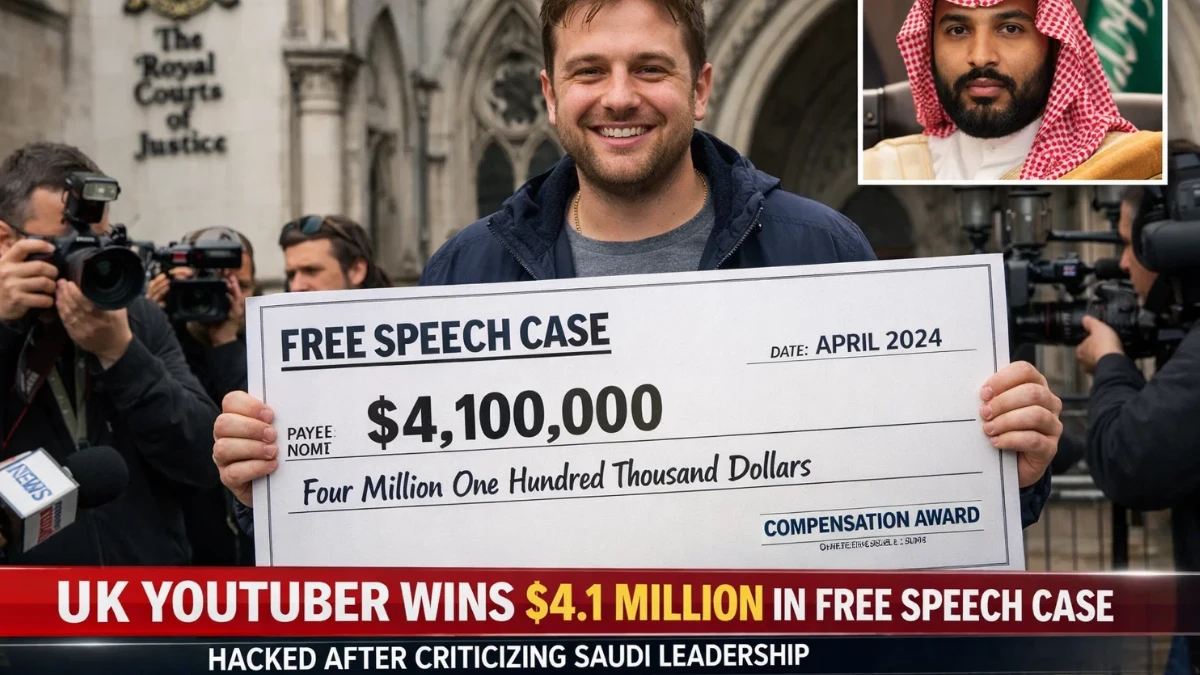
A UK-based YouTuber who openly criticized Saudi Arabia’s leadership has won a landmark legal victory, securing $4.1 million in damages after a British court ruled that he was deliberately targeted through hacking and intimidation because of his political views. The judgment is being hailed as a historic win for freedom of expression, digital privacy, and accountability in an age of cross-border cyber repression.
This case does not merely concern one individual. It sets a powerful precedent for online creators, journalists, dissidents, and activists worldwide who use digital platforms to speak truth to power.
Who Is the UK YouTuber at the Center of the Case?
The YouTuber involved in this case is a Saudi dissident living in exile in the United Kingdom. Known for his satirical and politically charged videos, he built a large following by openly criticizing the Saudi leadership, discussing corruption, governance issues, and human rights concerns.
Using humor, sharp commentary, and fearless language, his YouTube channel gained millions of views. His content resonated especially with younger audiences and Saudi citizens living abroad, many of whom felt silenced within their own country. What made his work particularly impactful was his ability to explain complex political issues in an accessible and engaging manner.
However, this popularity also made him a target.
Criticism of Saudi Leadership and the Risks of Speaking Out
Saudi Arabia is known for its strict controls on political dissent. Critics of the ruling establishment often face severe consequences, including imprisonment, travel bans, asset freezes, and harassment of family members. While many dissidents seek refuge abroad, this case demonstrates that exile does not always guarantee safety.
The YouTuber’s videos directly criticized senior figures within the Saudi leadership. He discussed alleged misuse of power, suppression of free speech, and lack of democratic accountability. These videos were not subtle; they were blunt, satirical, and widely shared across social media platforms.
As his influence grew, so did the risks.
The Cyber Attack: How the Hacking Unfolded
The court found that the YouTuber’s mobile phones were deliberately targeted using advanced hacking techniques. These were not ordinary cyber attacks carried out by amateur hackers. Instead, the methods used were consistent with state-level cyber surveillance operations.
His phones were compromised without any visible signs. Once infected, the attackers were able to:
- Access private messages and emails
- Monitor phone calls
- Track his location in real time
- Activate the microphone and camera remotely
- Collect sensitive personal and professional data
This level of intrusion effectively destroyed any sense of privacy. The court concluded that the hacking was directly linked to his political activities and criticism of Saudi leadership.
Psychological Impact of Being Under Constant Surveillance
One of the most devastating aspects of the hacking was the psychological toll it took on the victim. Knowing—or even suspecting—that every conversation, message, or movement might be monitored can be deeply traumatic.
According to court findings, the YouTuber experienced:
- Severe anxiety and paranoia
- Sleep disorders
- Loss of trust in technology
- Fear for personal safety
- Depression and emotional distress
He ultimately reduced his online activity, significantly impacting his income and career as a content creator.
The Physical Assault in London
The digital surveillance was not the end of the ordeal. The court also examined evidence related to a physical assault that occurred in London. The YouTuber was attacked by unidentified individuals, an incident that further reinforced fears that the cyber surveillance had enabled real-world targeting.
The timing and circumstances of the attack strongly suggested a connection between the hacking and the assault. Location data obtained through phone surveillance may have played a role in enabling the attackers to find him.
This combination of digital and physical intimidation became a central element of the legal case.
Legal Battle in the United Kingdom
The YouTuber filed a lawsuit in the UK, arguing that he had been unlawfully targeted, hacked, and assaulted as a result of his political opinions. The case raised complex legal questions, including:
- Whether a foreign state can be held accountable in UK courts
- The limits of state immunity
- Responsibility for cyber surveillance conducted abroad
- Protection of free speech under UK and international law
Saudi Arabia did not actively participate in the proceedings, but the court proceeded based on the evidence presented.
UK Court’s Historic Ruling
The UK court ruled decisively in favor of the YouTuber. The judge concluded that:
- The hacking was deliberate and targeted
- It was motivated by the claimant’s political opinions
- The actions constituted a serious violation of privacy and free speech
- The resulting psychological and financial harm was substantial
The court awarded $4.1 million in damages, covering:
- Loss of income from reduced online activity
- Psychological harm and emotional distress
- Violation of privacy
- Aggravated damages due to the severity of the conduct
This ruling is now considered one of the most significant legal decisions related to cyber surveillance and free speech in the UK.
Why This Case Is a Turning Point for Free Speech
This judgment sends a powerful message: critics of powerful governments cannot be silenced through hacking, intimidation, or violence without legal consequences.
For the first time, a court has clearly linked:
- Online political criticism
- State-level cyber surveillance
- Physical intimidation
- Financial and psychological harm
And held a foreign power accountable.
High-Value Legal and Policy Implications
From a legal perspective, this case is extremely important for several reasons:
1. State Accountability Across Borders
The ruling challenges the idea that governments can operate beyond the reach of law when targeting critics abroad.
2. Digital Privacy as a Human Right
The court recognized digital privacy as an extension of fundamental human rights, especially in the context of political expression.
3. Protection for Online Creators
YouTubers, journalists, and influencers now have stronger legal footing when facing cyber harassment linked to political speech.
Impact on Global Cyber Surveillance Debate
This case has reignited global debates around:
- Government use of spyware
- Regulation of surveillance technologies
- Accountability for misuse of cyber tools
- Ethical responsibilities of technology providers
As spyware becomes more sophisticated, legal systems are being forced to catch up.
What This Means for YouTubers and Digital Creators
For content creators worldwide, this ruling is both a warning and a reassurance.
Warning:
- Political content can carry real risks
- Digital security is no longer optional
Reassurance:
- Courts are increasingly willing to protect free speech
- Legal remedies exist, even against powerful actors
Creators are now encouraged to invest in cybersecurity awareness and digital safety practices.
Will the Compensation Be Paid?
One of the biggest questions remains whether the full compensation will actually be recovered. Enforcing a judgment against a foreign state can be complex. However, legal experts say the ruling itself is already a major victory, regardless of payment timelines.
Broader Context: A Global Pattern of Transnational Repression
This case fits into a wider global pattern where governments attempt to silence critics beyond their borders. From digital surveillance to intimidation of family members back home, such tactics have become increasingly common.
What makes this case unique is that it resulted in a clear legal consequence.
Also Read: Sharad Pawar Says Ajit Pawar Favoured NCP Merger on Feb 12 Before Plane Crash Stopped Talks
Conclusion: A Defining Moment for the Digital Age
The UK YouTuber’s $4.1 million victory is more than a personal win. It is a defining moment for free speech in the digital era. It proves that online voices matter, that digital repression leaves evidence, and that courts can serve as powerful defenders of human rights.
In an age where a single YouTube video can reach millions, this case confirms a fundamental truth: freedom of expression does not end at borders—and neither does justice.
FAQs: UK YouTuber Free Speech & Hacking Case
Q1. Why was the UK YouTuber targeted and hacked?
The YouTuber was targeted because of his satirical and critical content against Saudi Arabia’s leadership. His videos gained large international attention, which made him a perceived threat due to their political influence and reach.
Q2. What kind of hacking was involved in this case?
The court found evidence of advanced, state-level cyber surveillance that allowed attackers to access private data, track location, monitor communications, and remotely control phone functions without the user’s knowledge.
Q3. How did the hacking affect the YouTuber’s life and career?
The hacking caused severe psychological distress, forced him to reduce his online presence, and resulted in significant financial losses. His sense of personal safety and privacy was deeply compromised.
Q4. Was the hacking connected to a physical attack?
Yes. The UK court accepted that the digital surveillance likely enabled real-world tracking, which contributed to a physical assault against the YouTuber in London.
Q5. Why is this UK court ruling considered historic?
This is one of the first cases where a court directly linked foreign state cyber surveillance to violations of free speech and awarded substantial financial damages to a political dissident.

I’m a professional news publisher and passionate blogger, sharing trending stories, breaking news, and digital culture from around the world.