









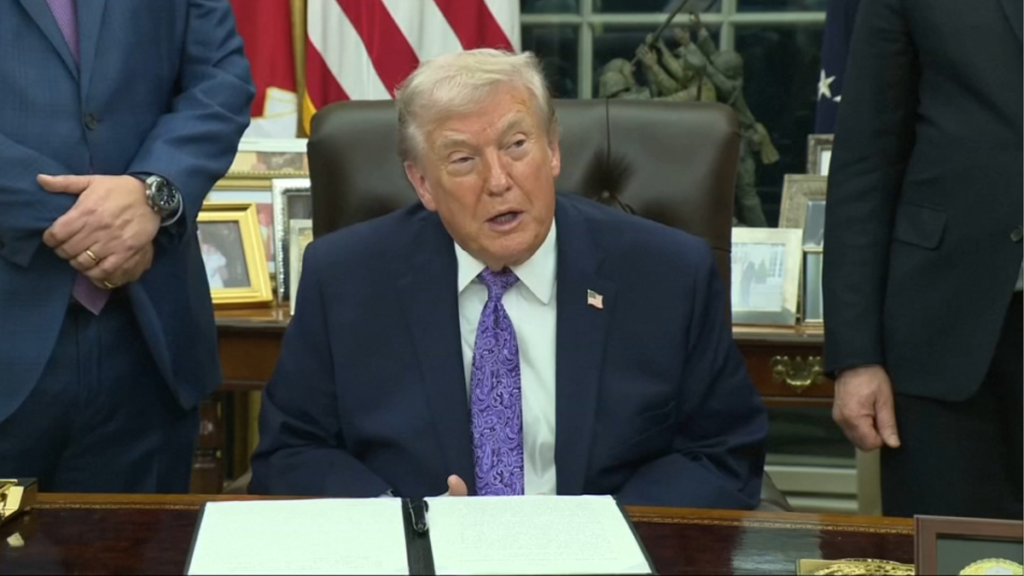
Trump Signs Executive Order Restricting AI -In a move that has sparked widespread debate across political, technological, and legal circles, former U.S. President Donald J. Trump has signed a major executive order aimed at restraining state governments from enacting independent regulations on artificial intelligence (AI). The decision marks one of the most significant federal interventions in the governance of AI in recent history. It underscores the intensifying national and global competition over AI leadership, safety frameworks, economic growth, and regulatory coherence.
The executive order centers on the federal government asserting its primacy over AI rules, effectively limiting the power of individual states to impose their own AI regulatory frameworks—including standards that govern safety, ethical principles, market practices, public data use, and algorithmic transparency. Supporters of the order argue that a unified national approach is necessary to preserve innovation, protect national competitiveness, and prevent a fragmented patchwork of state rules that could stifle technological advancement. Critics, meanwhile, contend that the move undermines state rights, reduces accountability, and risks sidelining important voices in public interest regulation.
This article explores the multifaceted implications of the executive order: its legal grounding and potential challenges, its impact on innovators and the tech industry, how states have reacted, implications for AI safety and ethics, historical context, comparisons to other regulatory landscapes, and the broader geopolitical stakes involved. It also provides expert analysis on what this means for consumers, companies, and public policy in the years ahead.
1. Background: AI Regulation in the United States
Artificial intelligence has rapidly evolved from academic laboratories and niche applications into an expansive force shaping healthcare, transportation, finance, defense, education, and everyday digital services. Yet this expansion has outpaced comprehensive legal frameworks designed to govern AI systems. Unlike traditional technologies, AI’s capacity for autonomy, large‑scale data processing, and predictive decision‑making raises distinct legal and ethical questions about transparency, fairness, accountability, discrimination, safety, and security.
Historically, the United States has taken a relatively hands‑off approach toward innovation, particularly in technology, favoring market‑driven developments and voluntary industry standards. But as AI’s influence has grown, so too has pressure on policymakers to establish clear regulations that protect individuals and society—without throttling innovation.
Before the executive order, states began exploring their own frameworks. For example, certain states proposed guidelines on data privacy, algorithmic fairness, and use of AI in public services. Some lawmakers argued that federal efforts lagged behind industry growth and that states should fill regulatory gaps.
Against this backdrop, the executive order asserts strong federal authority, emphasizing the need for consistent national policy over a mosaic of state mandates.
2. Key Provisions of the Executive Order
The executive order signed by President Trump includes multiple provisions designed to centralize AI regulatory authority at the federal level. Key elements include:
National Preemption of State AI Rules
The order stipulates that federal AI policies and regulations will preempt any state laws, rules, or executive actions that attempt to govern or restrict AI technologies independently. This means that states cannot impose standards, mandates, or prohibitions that differ from or expand upon federal AI policies.
Federal AI Regulatory Framework
It charges federal agencies with developing a cohesive set of AI guidelines covering safety, transparency, liability, and ethical considerations. These guidelines are intended to apply uniformly across all states and territories, with the goal of creating regulatory certainty for developers and users alike.
Innovation Incentives
The order includes measures to support AI research and development, such as increased federal funding for AI innovation hubs, tax incentives for AI startups, and streamlined federal review processes for new AI applications.
Federal Safety Standards
Federal agencies must develop standards for AI systems that pose high risks to public safety or civil liberties—such as autonomous vehicles, medical diagnostics tools, and systems that impact hiring, lending, or criminal justice decisions.
Interagency Coordination
A new interagency AI council is established to ensure cooperation among federal departments, harmonize regulatory activities, and serve as a central body for AI policy guidance.
International Alignment
The executive order emphasizes aligning U.S. AI governance with international partners, positioning the United States as a global leader in establishing norms and standards that balance innovation with risk management.
3. Federal Authority vs. State Autonomy
Legal Basis for Federal Preemption
The executive order is rooted in the constitutional principle that the federal government has the authority to regulate interstate commerce and national technological standards. Supporters of the order argue that AI, by its very nature, transcends state borders and therefore requires unified national governance. They assert that disjointed state regulations could create conflicts and inefficiencies for companies that operate nationally and internationally.
However, the preemption of state regulations raises constitutional questions about federalism and the balance of powers between federal and state governments. Traditionally, states have exercised regulatory authority in areas where federal law is silent or non‑exclusive. Critics of the order therefore raise concerns about whether the federal government has overstepped, potentially limiting states’ rights to protect their citizens.
Legal scholars anticipate challenges in the courts. Some state attorneys general have already signaled intentions to file lawsuits arguing that the executive order undermines established state powers and disrupts democratic governance at the local level.
State Reactions
States have responded variably. Several have voiced strong opposition, arguing that federal preemption will weaken protections that state legislatures wanted to establish—for example, guidelines to prevent AI bias in hiring or public surveillance. Others support the order, seeing value in a uniform approach that reduces regulatory complexity for businesses and encourages innovation.
Some state governments are exploring legal strategies to challenge the order, including lawsuits that cite constitutional provisions and precedents on federal‑state regulatory powers.
4. Impact on the Tech Industry
Innovation and Compliance
Industry leaders have largely welcomed the executive order, particularly large technology companies and AI startups. A unified federal framework promises to reduce regulatory uncertainty and compliance costs. Companies with operations across multiple states will no longer need to navigate a patchwork of differing state regulations.
Tech executives argue that clear federal standards will encourage investment and foster innovation without fear of conflicting local mandates. For example, developers of autonomous vehicle technology, AI‑driven medical tools, or financial recommendation systems prefer predictable and consistent rules.
Yet some industry voices raise concerns about one‑size‑fits‑all standards. They argue that overly prescriptive federal rules could stifle innovation or fail to adapt to rapidly changing technology. Small and mid‑sized enterprises that have embraced state‑level initiatives designed to prioritize ethical AI argue that a federal framework must include robust consumer safeguards.
Global Competitiveness
By centralizing AI regulation, the executive order positions the U.S. to compete more effectively with global powers like China and the European Union, both of which are advancing their own AI regulatory regimes. Proponents argue that a strong national policy can help American companies lead in global markets by setting interoperable standards rather than competing with a fragmented domestic landscape.
5. Public Safety, Ethics, and Accountability
AI Safety Standards

The executive order directs federal agencies to develop safety standards to manage high‑risk AI systems. These include technologies with the potential to significantly impact human life or civil rights, such as autonomous transportation, health diagnostic AI, and predictive policing systems.
Agencies are tasked with creating enforceable safety benchmarks that require testing, validation, and ongoing monitoring of AI systems before and after deployment. This aims to mitigate harms while promoting responsible innovation.
Ethical Considerations
Ethical AI principles—such as fairness, accountability, transparency, and non‑discrimination—are central to the policy discussion. The federal framework referenced in the executive order commits to incorporating these principles, but critics argue that the order does not go far enough in mandating enforceable ethical requirements.
Civil liberties advocates stress that without strong, enforceable ethical standards, AI systems could perpetuate bias in areas like credit scoring, hiring, and criminal justice. They call for transparency mandates that require companies and government agencies to disclose how AI systems make decisions.
Privacy Protections
The interaction between AI and personal data is a core concern. The federal order acknowledges the need for safeguarding privacy, but stops short of creating a comprehensive federal data privacy law. Instead, it proposes federal agencies incorporate privacy protections in their sectoral guidelines, which some experts see as insufficient.
6. Comparisons to International AI Regulation
European Union
The European Union’s AI regulatory framework—especially the proposed AI Act—aims to classify AI systems based on risk and impose corresponding restrictions. The EU model is often seen as stricter than U.S. approaches, emphasizing consumer protection and ethical standards.
In contrast, the U.S. executive order emphasizes innovation, economic competitiveness, and national leadership. It signals a commitment to balancing safety with market freedom, but with less emphasis on regulatory burden.
China
China’s AI governance strategy blends state oversight with industrial policy. It emphasizes national strategic goals, high‑tech leadership, data security, and social control mechanisms. The U.S. move toward federal preemption reflects a different governance philosophy: one that centralizes regulatory authority but aims to foster private sector innovation.
7. Potential Legal Challenges and Judicial Review
Legal experts anticipate that the executive order will face challenges in federal courts. Key questions include:
- Whether the federal government can preempt state AI regulation without explicit congressional authorization.
- Whether the order violates principles of federalism by undermining state sovereignty.
- Whether certain provisions are arbitrary or lack clear statutory grounding.
State governments and civil liberties groups are likely to mount lawsuits claiming that the order exceeds executive authority and limits democratic regulatory processes at the state level. These cases could lead to significant judicial interpretation of federal‑state powers in emerging technology governance.
8. Implications for Consumers
Consumers may feel the effects of the executive order in multiple ways:
Clarity and Consistency
Unified national standards could make it easier for consumers to understand how AI applications affect them, especially when technology crosses state lines.
Safety and Trust
If federal safety and ethical standards are strong and enforceable, consumers could benefit from improved protections against harmful or biased AI systems.
Access to Innovation
Reduced regulatory fragmentation could accelerate the deployment of new technologies—benefiting consumers with access to advanced AI tools in healthcare, transportation, and personalized services.
Concerns About Oversight
Some consumer advocates worry that federal dominance in AI rules could reduce opportunities for diverse policy experiments at the state level that tailor protections to local needs.
9. Broader Political and Economic Stakes
The executive order reflects broader political tensions between federal authority and state autonomy, especially in a polarized political environment. It also highlights the economic importance of AI as a driver of future growth, job creation, and national competitiveness.
Economists note that inconsistent regulations can fragment markets and slow investment. A national approach, they argue, could streamline innovation and encourage global competitiveness. But political scientists also stress that democratic governance requires preserving space for diverse policy experiments, which states traditionally provide.
Also Read: https://trendnewspulse.com/slovakia-signals-eu/
Conclusion
The executive order signed by President Trump restricting state regulation of AI represents a defining moment in the governance of emerging technology in the United States. By asserting federal primacy, the administration has sought to create a unified national framework intended to drive innovation, reduce regulatory complexity, and position the U.S. as a global leader in AI development.
However, the policy has ignited debate over state rights, ethical safeguards, consumer protections, and the appropriate balance between innovation and regulation. Future legal challenges and judicial review will clarify the constitutional boundaries of federal authority in AI governance. Meanwhile, industry stakeholders, civil liberties advocates, and state governments will continue to navigate the implications of this landmark policy shift.
As AI technologies grow in sophistication and influence, the debate over how best to regulate them will remain central to public policy, economic strategy, and societal values. This executive order marks an important chapter in that ongoing journey.
FAQs
1. What does the executive order do?
It restricts states from creating their own AI regulations, asserting that federal rules must take precedence.
2. Why did the Trump administration issue it?
To create uniform national AI rules, avoid regulatory fragmentation, and support innovation.
3. Will states still have any say in AI governance?
States may challenge the order legally, but until courts rule otherwise, federal authority will override conflicting state regulations.
4. How does this affect tech companies?
Companies may benefit from a consistent national framework that reduces compliance costs and regulatory complexity.
5. Does it address AI safety and ethics?
Yes, the order directs federal agencies to develop safety standards and ethical guidelines, though critics say these may not be strict enough.

I’m a professional news publisher and passionate blogger, sharing trending stories, breaking news, and digital culture from around the world.