









Introduction
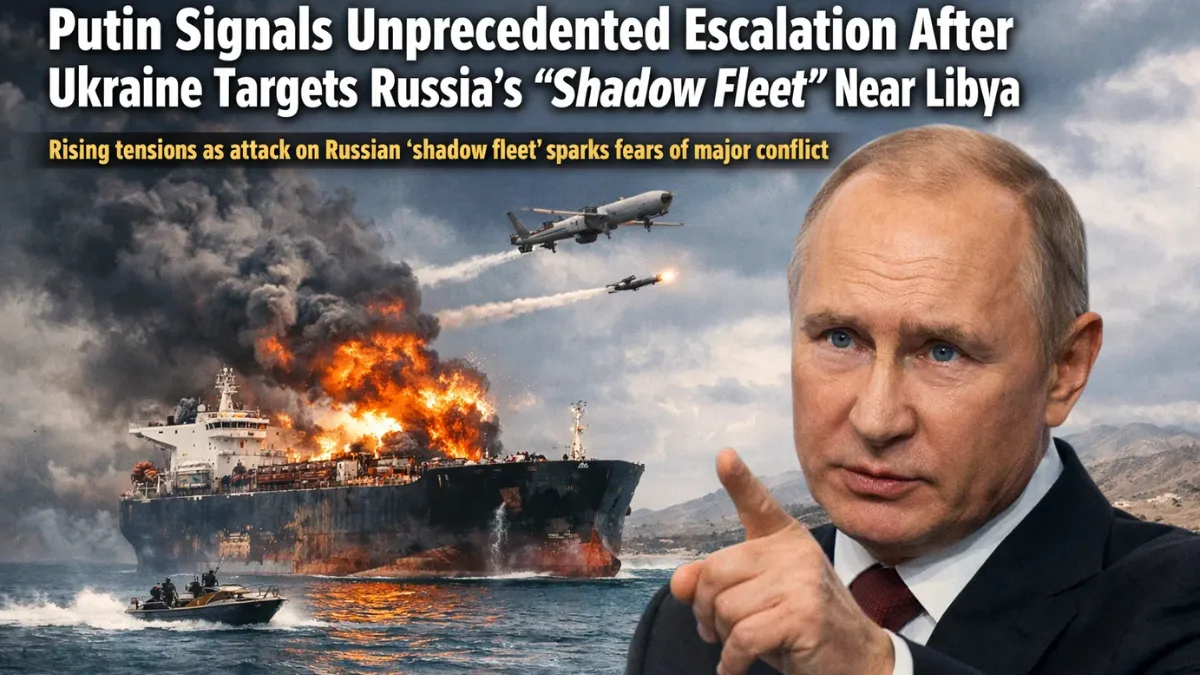
Putin -The Russia–Ukraine war has entered a dangerous and unprecedented phase as Ukrainian forces carried out a bold strike against a Russian-linked oil tanker in the Mediterranean Sea, far from the traditional frontlines of the conflict. The attack, which reportedly took place near the Libyan coast, has drawn a sharp and ominous response from Russian President Vladimir Putin, who warned that such actions would invite serious consequences. The incident marks the first known Ukrainian military operation targeting Russian economic assets so deep into international waters, signaling a dramatic expansion of the battlefield.
For nearly three years, the war has largely remained confined to Ukrainian territory, the Black Sea region, and border areas. However, this latest strike has shattered assumptions about geographical limits. By targeting what Ukraine describes as Russia’s “shadow fleet,” Kyiv has sent a clear message: Russian economic lifelines are no longer safe, even thousands of kilometers from the war zone. The implications of this shift are profound, touching global energy markets, maritime security, and international diplomacy.
President Putin’s reaction has further intensified global anxiety. In strongly worded remarks, the Russian leader accused Ukraine of crossing a red line and hinted at retaliation that could escalate the conflict beyond its current scope. His comments have fueled speculation about possible Russian countermeasures, including naval responses, expanded missile strikes, or indirect actions against Ukrainian allies.

As world powers assess the fallout, the strike raises urgent questions. What is Russia’s shadow fleet, and why is it so critical to Moscow’s war effort? How did Ukraine develop the capability to strike so far from home? And most importantly, does this incident mark the beginning of a broader global confrontation with consequences far beyond Eastern Europe?
This article provides an in-depth examination of the incident, its strategic meaning, Putin’s escalation warning, and the wider geopolitical risks now confronting the world.
The Mediterranean Strike: What Happened
According to Ukrainian officials, the operation targeted a Russian-linked oil tanker operating in the Mediterranean Sea near Libya. The vessel was identified as part of Russia’s so-called shadow fleet — a network of ships used to transport oil while evading international sanctions. The strike was reportedly carried out using long-range unmanned aerial vehicles, marking one of the most distant Ukrainian military operations since the war began.
The tanker was damaged but did not cause a major environmental disaster, as it was reportedly not fully loaded at the time. Ukrainian authorities framed the operation as a strategic move aimed at weakening Russia’s ability to finance its war through oil exports. They emphasized that the vessel was a legitimate target because its operations directly supported Russia’s military campaign.
The location of the strike is what stunned observers. The Mediterranean Sea, particularly near North Africa, has long been considered outside the active conflict zone. It is a region used daily by commercial shipping, energy transport, and naval patrols from multiple nations. By conducting an attack there, Ukraine demonstrated not only technical reach but also strategic audacity.
This operation has effectively expanded the war from a regional land conflict into a broader confrontation involving international waters and global trade routes.
Understanding Russia’s ‘Shadow Fleet’

The term “shadow fleet” refers to a large, loosely connected network of aging oil tankers and cargo vessels that operate under complex ownership structures. These ships often sail under flags of convenience, frequently change names, disable tracking systems, and use intermediaries to disguise the origin of Russian oil.
Since Western sanctions were imposed on Russian energy exports, this fleet has become a crucial tool for Moscow. By selling oil at discounted prices through indirect channels, Russia has managed to sustain a significant portion of its revenue despite international pressure. The money generated through these operations plays a vital role in funding military production, paying troops, and stabilizing the Russian economy during wartime.
The shadow fleet operates in legal gray zones. While many of its activities skirt international regulations, enforcement has been inconsistent due to jurisdictional challenges and the sheer scale of global maritime traffic. This has made the fleet both effective and difficult to dismantle through sanctions alone.
Ukraine’s decision to target this network militarily represents a shift from economic and diplomatic pressure to direct action.
Why Ukraine Chose This Target
Ukraine has long argued that Russia’s energy exports are the backbone of its war machine. While sanctions have reduced profits, they have not eliminated revenue streams. By striking the shadow fleet, Ukraine aims to raise the cost of doing business for Russia, forcing insurers, port authorities, and ship owners to reconsider involvement.
There is also a psychological dimension. The strike sends a signal that distance no longer guarantees safety. Russian assets, whether military or economic, may now face threats far beyond the Black Sea or Eastern Europe.
From Kyiv’s perspective, the operation demonstrates resilience and innovation. Despite facing shortages in ammunition and air defense, Ukraine has invested heavily in drone technology. Long-range unmanned systems have become a cornerstone of its strategy, allowing it to compensate for disadvantages in conventional firepower.
This strike reinforces Ukraine’s narrative that it is capable of adapting and striking strategically significant targets even under pressure.
Putin’s Response: A Warning of Escalation
President Vladimir Putin responded swiftly and forcefully. In public remarks, he condemned the attack as reckless and provocative, accusing Ukraine of endangering international shipping and destabilizing global security. More importantly, he warned that Russia would not leave such actions unanswered.
Putin’s language was deliberately ambiguous but unmistakably threatening. He suggested that Ukraine’s actions could lead to “unpredictable consequences” and hinted that Russia might expand its own range of targets. Analysts interpret this as a signal that Moscow could consider retaliation beyond Ukrainian territory or against assets indirectly supporting Kyiv.

The warning serves multiple audiences. Domestically, it reassures Russian citizens that the Kremlin remains strong and resolute. Internationally, it is a message to Ukraine’s allies that continued support may carry growing risks.
While Putin stopped short of announcing specific measures, the tone of his remarks suggests that Moscow views the Mediterranean strike as a significant escalation rather than a symbolic gesture.
Potential Russian Responses
Russia has several options if it chooses to retaliate.
One possibility is intensified attacks on Ukrainian infrastructure, particularly energy facilities, ports, and transportation networks. Such strikes could aim to disrupt Ukraine’s economy during critical periods.
Another option is maritime escalation. Russia could increase naval patrols, escort shadow fleet vessels with military ships, or conduct exercises in sensitive regions as a show of force.
Cyber operations also remain a likely avenue. Russia has a history of using cyberattacks to target infrastructure, financial systems, and communication networks. These actions allow Moscow to respond forcefully while maintaining plausible deniability.
Finally, Russia could attempt to pressure Ukraine’s allies through indirect means, including diplomatic maneuvers, energy leverage, or strategic partnerships with adversaries of the West.
Each of these options carries risks, particularly the danger of drawing additional actors into the conflict.
Implications for Global Maritime Security
The Mediterranean is one of the world’s busiest maritime corridors. Any military activity in this region raises alarms among shipping companies, insurers, and coastal states.
Following the strike, concerns have grown about the safety of commercial vessels operating near contested areas. Even the perception of risk can increase insurance premiums, delay shipments, and disrupt supply chains.
Energy markets are particularly sensitive. Oil transported through the Mediterranean affects prices and availability across Europe, Africa, and beyond. Any escalation that threatens tanker traffic could have immediate economic consequences.
Naval forces from multiple countries operate in the region, increasing the risk of miscalculation or accidental encounters. As military activity expands into shared spaces, the margin for error narrows significantly.
International Reactions and Strategic Dilemmas
Reactions from the international community have been mixed. Ukraine’s supporters emphasize its right to self-defense and the legitimacy of targeting economic assets that fund aggression. Others express concern that expanding the conflict into international waters could undermine global stability.
Some governments worry that normalizing attacks on commercial-linked vessels sets a dangerous precedent. If economic assets become standard military targets, future conflicts could increasingly disrupt global trade.
Neutral countries, particularly those in the Mediterranean and North Africa, face difficult choices. While they may wish to avoid involvement, the proximity of military operations forces them to consider enhanced security measures and diplomatic engagement.
A Turning Point in Modern Warfare
This incident reflects a broader evolution in warfare. Modern conflicts increasingly target economic systems, logistics networks, and financial flows rather than solely focusing on battlefield victories.
Drones, cyber tools, and long-range precision strikes allow smaller or weaker states to project power far beyond traditional limits. The line between military and economic targets continues to blur.
Ukraine’s strike against the shadow fleet exemplifies this trend. It is not just a tactical move but a strategic statement about the future of conflict in a globalized world.
Risks of Miscalculation
Perhaps the greatest danger lies in miscalculation. As actions grow bolder and responses more forceful, the risk of unintended escalation increases.
A retaliatory strike could provoke a counter-response. A naval incident could draw in additional forces. What begins as a targeted operation could spiral into a wider confrontation.
History shows that major conflicts often escalate not through deliberate planning but through a series of reactions, each justified as defensive. The Mediterranean strike fits uncomfortably into this pattern.
Also Read: Gemini App Update: Edit Your Creations with Nano Banana by Drawing
Conclusion: A Conflict Without Clear Boundaries
The Ukrainian strike on Russia’s shadow fleet near Libya marks a defining moment in the ongoing war. It demonstrates Ukraine’s growing reach, Russia’s heightened sensitivity to economic threats, and the fragile nature of global security in an interconnected world.
Putin’s warning of unprecedented escalation underscores the gravity of the situation. The conflict is no longer confined by geography or traditional rules. Economic assets, international waters, and distant regions are now part of the battlefield.
As the world watches, the key question remains whether restraint or retaliation will shape the next phase. The answer will determine not only the future of the Russia–Ukraine war but also the stability of global trade, energy markets, and international relations.
Frequently Asked Questions (FAQs)
Q1. What is Russia’s shadow fleet?
It is a network of vessels used to transport Russian oil while avoiding sanctions through complex ownership and tracking methods.
Q2. Why did Ukraine target a tanker near Libya?
Ukraine aimed to disrupt Russia’s oil revenue, which helps fund its military operations, and to demonstrate its ability to strike far from home.
Q3. How did Putin respond to the attack?
He warned of serious consequences and signaled that Russia may escalate its response.
Q4. Why is this strike considered unprecedented?
It represents Ukraine’s first known military action against Russian-linked assets in the Mediterranean, far outside the traditional war zone.
Q5. What are the global risks?
Potential risks include disruption of maritime trade, rising energy prices, and broader geopolitical escalation.

I’m a professional news publisher and passionate blogger, sharing trending stories, breaking news, and digital culture from around the world.