










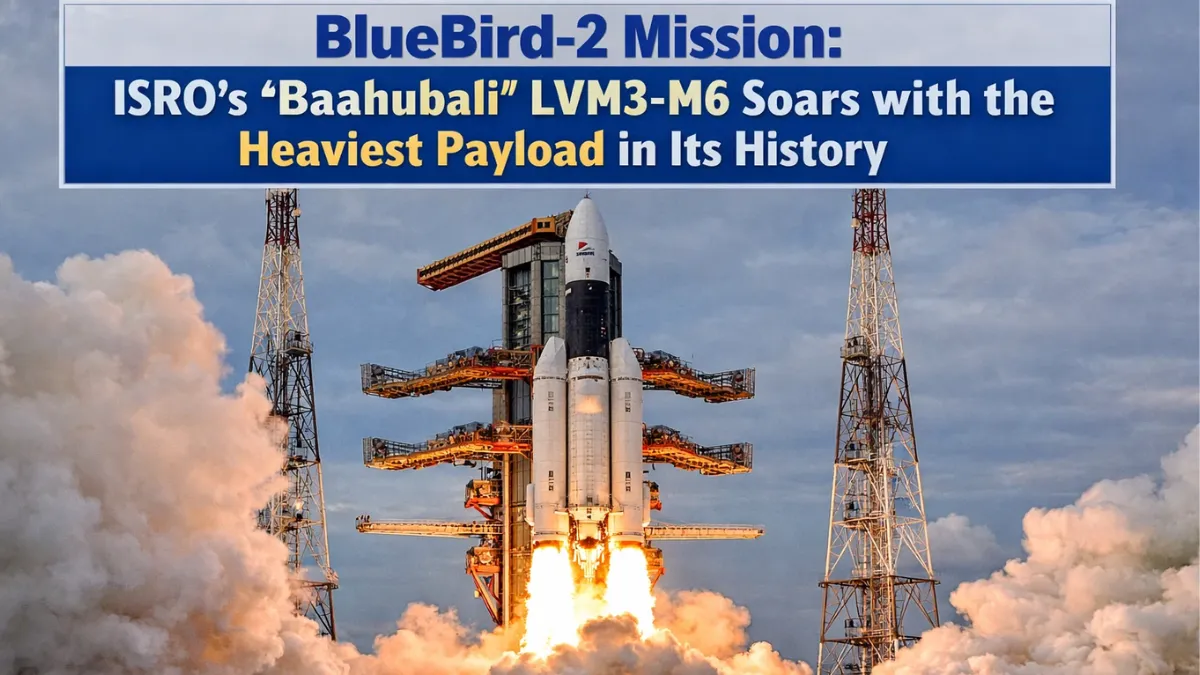
BlueBird-2 Mission- India scripted a historic chapter in global spaceflight on December 24, 2025, when the Indian Space Research Organisation (ISRO) successfully launched the LVM3-M6 mission, popularly known as the ‘Baahubali’ rocket, carrying the BlueBird-2 (BlueBird Block-2) satellite — the heaviest payload ever lifted by an Indian launch vehicle.
The spectacular liftoff took place at 08:54 AM IST from the Second Launch Pad at the Satish Dhawan Space Centre (SDSC), Sriharikota, as the massive rocket thundered into the sky, marking a decisive leap in India’s commercial and technological space capabilities.
This mission is being widely hailed as a game-changer, not just for ISRO, but for the global satellite communications industry.

A Defining Moment for Indian Spaceflight
The LVM3-M6 launch stands as a symbol of India’s rising dominance in heavy-lift launch services. Until recently, India was primarily known for cost-effective small and medium satellite launches. With this mission, ISRO has firmly entered the elite league of nations capable of launching ultra-heavy commercial payloads.
The successful deployment of the BlueBird-2 satellite, weighing approximately 6,100 kilograms, shattered all previous records held by Indian launch vehicles. Never before had ISRO placed such a massive satellite into Low Earth Orbit (LEO).
Launch Details at a Glance
- Mission Name: LVM3-M6 / BlueBird-2 Mission
- Launch Date: December 24, 2025
- Launch Time: 08:54 AM IST
- Launch Site: Second Launch Pad, SDSC SHAR, Sriharikota
- Launch Vehicle: LVM3 (Gaganyaan-class heavy-lift rocket)
- Payload Mass: ~6,100 kg
- Orbit: Low Earth Orbit (LEO)
- Mission Type: Commercial satellite launch
Meet ‘Baahubali’: India’s Most Powerful Rocket
The Launch Vehicle Mark-3 (LVM3) — affectionately called ‘Baahubali’ — is ISRO’s most powerful operational rocket.
Standing over 43 meters tall and weighing more than 640 tonnes at liftoff, the LVM3 is designed to carry heavy satellites and human spaceflight missions.
Three-Stage Powerhouse
- Twin Solid Boosters: Provide enormous thrust during liftoff
- Liquid Core Stage: Ensures stability and sustained acceleration
- Cryogenic Upper Stage: Enables precise orbital insertion
This configuration allowed the rocket to carry its heaviest payload ever without compromise, underlining the maturity and reliability of India’s launch systems.
BlueBird-2 Satellite: A Technological Marvel
The BlueBird-2 satellite is a next-generation communication spacecraft built for direct-to-mobile connectivity. Unlike traditional satellites, it is designed to connect directly with ordinary smartphones, without the need for ground towers or special hardware.
Key Capabilities
- Direct voice, data, and broadband services from space
- Works with standard mobile phones
- Supports 4G and future 5G connectivity
- Massive phased-array antenna spanning hundreds of square meters
- Designed for global coverage, including oceans and remote regions
Once fully operational, BlueBird-2 will play a critical role in bridging the digital divide, especially in rural, remote, and disaster-affected areas.
A Commercial Milestone for ISRO

This mission was executed under a commercial agreement through NewSpace India Limited (NSIL), ISRO’s commercial arm. The success of LVM3-M6 significantly boosts India’s standing in the global commercial launch market, traditionally dominated by a handful of spacefaring nations.
Why This Matters
- Demonstrates India’s capability to launch very heavy foreign satellites
- Enhances confidence among international commercial clients
- Positions ISRO as a reliable alternative for large satellite launches
- Strengthens India’s space economy and private-sector participation
Flawless Countdown and Liftoff
The 24-hour countdown leading up to the launch proceeded smoothly, with mission teams completing all system checks, fueling operations, and safety clearances on schedule.
At liftoff, the rocket’s solid boosters ignited with a deafening roar, sending shockwaves across Sriharikota as the vehicle rose majestically into the morning sky.
Within minutes:
- Solid boosters separated successfully
- Core stage performed nominally
- Cryogenic engine fired with precision
Approximately 15 minutes after launch, the BlueBird-2 satellite was successfully separated and placed into its intended orbit — confirming mission success.
India’s Expanding Space Ambitions

The success of LVM3-M6 adds to a growing list of achievements that include:
- Lunar missions
- Interplanetary exploration
- Human spaceflight preparations
- Large-scale commercial launches
ISRO is now actively working toward:
- Increasing payload capacity further
- Developing semi-cryogenic engines
- Reducing launch turnaround times
- Supporting future space station and deep-space missions
This mission strengthens the foundation for India’s long-term leadership in space technology.
Global Applause and National Pride
The launch triggered widespread appreciation from political leaders, scientists, engineers, and space enthusiasts across the world.
Indian leadership praised the mission as:
- A testament to Indian scientific excellence
- A boost to “Make in India” in high-tech sectors
- A symbol of India’s growing influence in global space affairs
For millions of Indians, the mission became a moment of pride, reinforcing the belief that India is no longer just a participant, but a leader in the new space age.
What Happens Next
Following orbital insertion, the BlueBird-2 satellite will undergo:
- Deployment of its massive antenna
- In-orbit testing and calibration
- Gradual entry into commercial service
Once fully operational, it will help deliver space-based mobile connectivity across continents, redefining how people stay connected.
Also Read: Saudi Arabia Sees Snow for First Time in 30 Years: What’s Behind This Desert Chill?
Conclusion: A Giant Leap Beyond the Sky
The BlueBird-2 Mission is not merely a successful launch — it is a statement of intent.
With the LVM3-M6 mission, ISRO has proven that India can:
- Launch the heaviest satellites
- Compete in the global commercial market
- Deliver cutting-edge space solutions
- Shape the future of global connectivity
As the ‘Baahubali’ rocket fades into history books, it leaves behind a powerful message — India’s journey to the stars has only just begun.
Frequently Asked Questions (FAQs)
Q1. What is the BlueBird-2 Mission?
The BlueBird-2 Mission is a commercial satellite launch by ISRO using the LVM3-M6 rocket to place the BlueBird-2 communication satellite into Low Earth Orbit.
Q2. When was the BlueBird-2 satellite launched?
The satellite was launched on December 24, 2025, at 08:54 AM IST.
Q3. Why is this mission historic for ISRO?
It carried the heaviest payload ever launched by an Indian rocket, weighing around 6,100 kg.
Q4. What is special about the LVM3 ‘Baahubali’ rocket?
LVM3 is India’s most powerful rocket, capable of heavy-lift missions and human spaceflight.
Q5. What is the purpose of the BlueBird-2 satellite?
Its purpose is to provide direct-to-mobile broadband connectivity, including voice and data services, using standard smartphones.
Q6. Which orbit was BlueBird-2 placed into?
The satellite was deployed into Low Earth Orbit (LEO).
Q7. How does this mission help India commercially?
It boosts India’s credibility as a global commercial launch provider, attracting future international clients.
Q8. Will BlueBird-2 improve internet access?
Yes, it aims to deliver connectivity in remote, rural, and disaster-prone regions where traditional networks are unavailable.

I’m a professional news publisher and passionate blogger, sharing trending stories, breaking news, and digital culture from around the world.