









Introduction
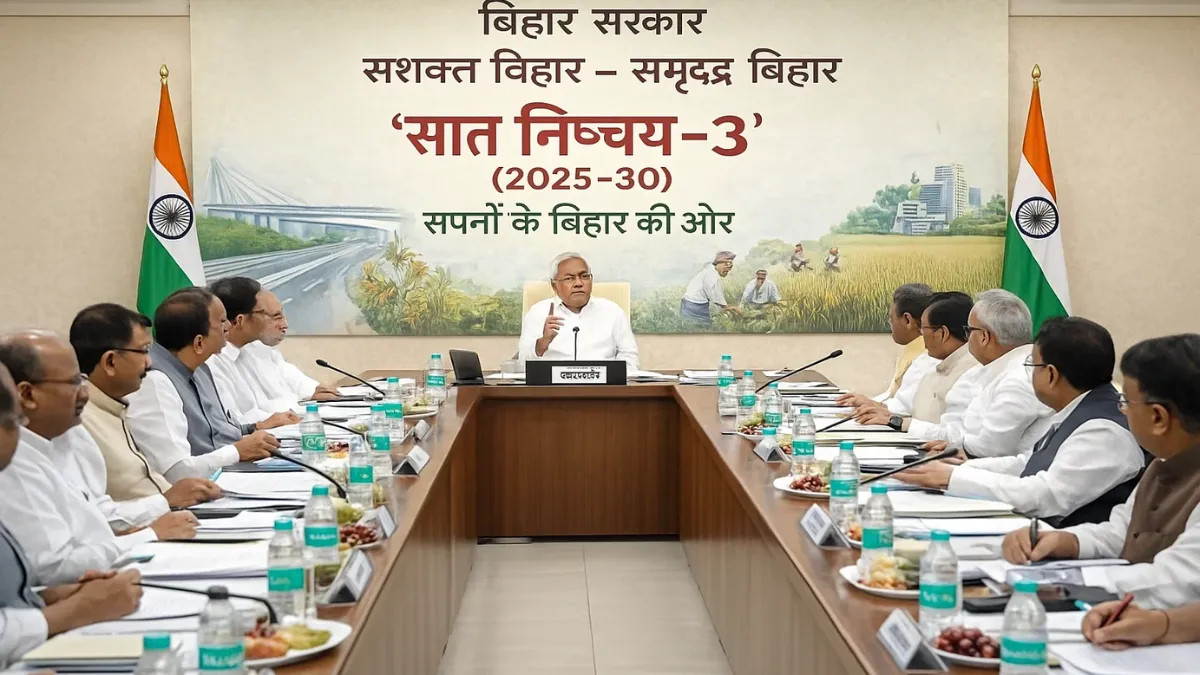
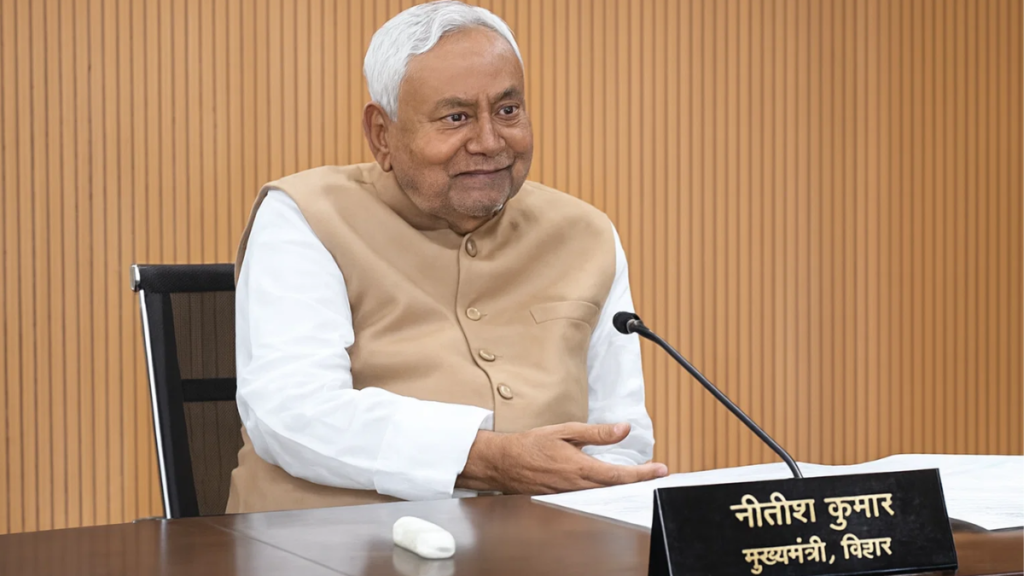
On December 16, 2025, the Bihar Cabinet, led by Chief Minister Nitish Kumar, cleared the ambitious “Saat Nischay-3” (Seven Resolves Part-3) Development Programme for the period 2025–2030. The new framework builds on more than a decade of sustained efforts under the Saat Nischay umbrella—a seven-pillar strategy focused on inclusive development, welfare expansion, infrastructure growth, and economic transformation in Bihar. While detailed official documentation is being released progressively, media coverage and government briefings outline a bold agenda shaped around deepening economic opportunities, social services access, infrastructure upgrades, and income-raising measures for citizens of all backgrounds.
This article comprehensively explains Saat Nischay-3’s components, strategic goals, implementation roadmap, impact on sectors such as youth employment, education, health, agriculture, industry and infrastructure, comparisons with previous phases, potential challenges and opportunities, and expert perspectives.
1. Historical Context: The ‘Saat Nischay’ Initiative
1.1 The Genesis (Part-1 and Part-2)
The Saat Nischay (“Seven Resolves”) initiative was first introduced by the Bihar government under Chief Minister Nitish Kumar with a focus on transforming the state’s socio-economic landscape through a holistic set of pledges aimed at improving basic services, quality of life, and economic prospects of citizens. Though originally launched years ago, the program gained renewed traction with redesigned phases:
- Part-1 focused on foundational services like electricity for all households, piped drinking water, roads and sanitation, education access, skill development, and women’s empowerment, making these services universally accessible.
- Part-2 spanned the year 2020–25 and included a stronger emphasis on livelihood support, employment readiness, financial assistance to youth for self-help and entrepreneurship, and infrastructure modernization. Under Part-2, several youth benefit schemes and income support programs were expanded to include more graduates and skilled youth.
Both earlier phases served as foundation stones for socio-economic interventions, with measurable results in increased rural connectivity, improved access to public services, and initial job creation engines.
1.2 Why a Part-3?
Despite significant progress, Bihar continues to face challenges such as high unemployment rates among youth, underdeveloped industrial ecosystems, agricultural productivity constraints, and uneven quality in health and education services. Part-3 is positioned not merely as an extension of earlier promises but as a structural shift towards deeper economic transformation—integrating modern technological frameworks, industry-driven growth agendas, and sustainable job creation targets.
2. Core Vision and Strategic Goals
2.1 What Saat Nischay-3 Aims to Achieve
At its core, Saat Nischay-3 acts as Bihar’s comprehensive development roadmap for the next five years, focusing on:
- Doubling employment opportunities and income across sectors;
- Industrial prosperity and regional competitiveness;
- Advanced agricultural growth and farm incomes;
- Upgrading education systems for the future workforce;
- Accessible, quality healthcare for all citizens;
- Robust infrastructure and digital readiness; and
- Ensuring dignity, respect and accessible governance for all communities.
This “seven pillars” framework ensures that economic opportunity, social welfare, and infrastructure modernization are pursued in an integrated manner across rural and urban spaces.
3. Job Creation and Youth Empowerment
3.1 Targeting One Crore Jobs
A signature goal of Saat Nischay-3 is the state’s commitment to generating 1 crore (10 million) employment opportunities from 2025 to 2030. This target reflects a substantial scaling up from earlier initiatives and involves public-private partnerships, industry-driven hiring skilling, and economic diversification.
To achieve this, the cabinet approved the creation of three dedicated government departments:
- Department of Youth, Employment and Skill Development – focusing on large-scale skilling, apprenticeships, and job placement services;
- Department of Higher Education – ensuring quality university and technical education;
- Department of Civil Aviation – to integrate Bihar’s expanding aviation ecosystem into economic and job growth sectors.
These new departments will have tailored mandates to coordinate with industry bodies, educational institutions, and tech partners for job readiness and employment absorption.
3.2 Skill Development Initiatives
Skill development is central to ensuring that Bihar’s large youth population is job-ready for sectors such as digital services, manufacturing, logistics, tourism, healthcare, and engineering. Though detailed schemes are still emerging, early outlines point to:
- Partnerships with National Stock Exchange India Limited for skill programs;
- Internships linked to industry placements;
- Incentives for employers to hire trained youth.
This combination of policy, public investment, and implementation infrastructure aims to address structural mismatches between education output and labor market needs.
4. Education, Innovation and Technology
4.1 Higher Education Expansion
The Department of Higher Education will champion reforms in Bihar’s college and university systems. This includes:
- Upgrading curriculum with industry relevance;
- Promoting research, innovation and venture incubation;
- Creating technology-oriented programs to support future workforce competencies.
Improved higher educational outcomes are expected to strengthen local talent pools, attract investment and reduce migration of youth for educational and job opportunities outside the state.
4.2 Skill Ecosystems and Digital Literacy
Beyond formal education, Bihar plans to significantly scale digital literacy and access, ensuring that students and job seekers are competent in high-demand areas such as AI, data analytics, coding, and digital services—essential components of a “New Age Economy.”
5. Agriculture and Rural Prosperity
Agriculture remains a backbone of Bihar’s economy—employing a majority of rural households. Saat Nischay-3 promotes:
- Improved irrigation infrastructure;
- Modern crop technology adoption;
- Farmer income incentives, including market linkages and value addition;
- Focused rural development investments tailored to local agro-ecological strengths.
While specifics will evolve with sectoral planning, the integration of agricultural modernization with rural livelihood support underscores Bihar’s broader vision of inclusive prosperity.
6. Infrastructure and Connectivity Boost
6.1 Transport and Logistics
Transport infrastructure is essential for economic growth, and Bihar’s cabinet decisions over the past year reflect this priority—approving highways, rail projects, and road upgrades worth several thousand crores (e.g., regional highways, rail line expansions).
Improved corridors strengthen connectivity between agricultural hubs, industrial clusters, and neighboring markets.
6.2 Industrial Zones and Special Economic Areas
Industrial development authorities such as Bihar Industrial Area Development Authority (BIADA) are expanding industrial areas across numerous districts with investment plans to develop thousands of acres of industrial land. These zones aim to attract large-scale manufacturing, logistics, and export-oriented enterprises, contributing to job creation and economic diversification.
7. Health and Quality of Life Enhancements
Accessible and quality healthcare is a pillar of Saat Nischay-3. Planned interventions include:
- Expansion of healthcare infrastructure such as hospitals and primary care centers;
- Strengthening preventive health systems;
- Improved nutrition programs for vulnerable groups.
Through these measures, the government intends to reduce disease burdens and improve health indices across the state.
8. Social Equity, Women’s Empowerment and Citizen Services
Women’s empowerment and social equity remain core commitments. Earlier Saat Nischay phases introduced measures such as reservation in jobs and financial incentives for women entrepreneurs. Part-3 is expected to deepen these commitments by:
- Enhancing self-help grants and financial support structures for women;
- Strengthening social safety nets;
- Ensuring universal access to basic services like clean water, sanitation and electricity.
9. Governance, Implementation and Monitoring
9.1 Institutional Architecture
To ensure successful rollout and monitoring, the Bihar government plans to:
- Establish high-powered committees and cross-departmental task forces;
- Strengthen data and performance monitoring systems;
- Use digital platforms for transparency and citizen feedback.
These institutional mechanisms will help track progress, identify bottlenecks, and ensure accountability.
9.2 Funding and Resource Planning
Implementation will require sustained budget allocations from the state and support from central schemes where possible. Innovative financing mechanisms such as public-private partnerships and investment facilitation bodies are also expected.
10. Expected Impact on Key Sectors
| Sector | Impact Outlook |
|---|---|
| Jobs & Employment | Target of 1 crore jobs through skill development, industry partnerships and youth-centric departments. |
| Education | Higher standards in higher education, new programs, research emphasis, digital skills. |
| Agriculture | Irrigation, value addition, rural incomes, enhanced productivity. |
| Infrastructure | Major highways, rail networks, industrial zone connectivity, logistics improvements. |
| Healthcare | Increased access, preventive measures, strengthened health infrastructure. |
| Industry | Expansion of industrial clusters, growth of MSMEs and manufacturing sectors. |
| Social Services | Expanded welfare services for women, marginalized groups and citizens at large. |
11. Comparisons With Earlier Phases
| Feature | Saat Nischay-1 | Saat Nischay-2 (2020-25) | Saat Nischay-3 (2025-30) |
|---|---|---|---|
| Basic Services Focus | ✔ Electricity, water | ✔ Enhanced access | ✔ Continued + Quality improvements |
| Employment Emphasis | ✔ Skill training | ✔ Youth stipend programs | ✔ 1 crore jobs target + Skill-Industry linkages |
| Industrial Push | – | Limited infrastructure | ✔ Special zones + industry expansion |
| Education Reform | ✔ Access improvements | ✔ Financial support | ✔ Quality & Higher education reform |
| Governance Architecture | – | Moderate coordination | ✔ New dedicated departments |
The transitions show a clear evolution from basic welfare provisioning toward a structured economic development strategy with measurable impact goals and institutional oversight.
12. Challenges and Opportunities
12.1 Implementation Challenges
Despite strong visions, Bihar faces challenges such as:
- Ensuring coordinated execution across departments;
- Matching skill supply with industry demand;
- Scaling services to remote rural areas;
- Avoiding implementation delays in large projects.
12.2 Strategic Opportunities
Conversely, Saat Nischay-3 provides the state opportunities to:
- Leverage its large youth workforce;
- Position itself as an economic hub in eastern India;
- Attract national and global investment;
- Integrate technology and innovation into public services.
13. Experts’ Perspectives
Economists and policy analysts note that Bihar’s push toward a jobs-and-industry oriented agenda elevates the state’s development strategy from basic service provisioning (Part-1 and Part-2) to an economic growth and competitiveness framework. If successfully implemented, it could significantly raise household incomes, reduce migration pressures, and boost GDP growth trajectory.
14. Case Studies: Early Signals of Change
Although Part-3 implementation has just begun, existing initiatives provide insight:
- Highway and rail connectivity projects are improving transport time and regional access.
- Industrial land expansion across 26 districts encourages investment inflows.
- Youth grants inclusion to graduates under existing schemes enhances employability.
These examples reflect how policy commitments translate into ground-level development actions.
Also Read: MGNREGA Set for Overhaul as Govt Rolls Out Viksit Bharat G RAM G Employment Scheme
Conclusion
The Bihar Cabinet’s approval of Saat Nischay-3 for 2025–30 is a bold and forward-looking step that reflects maturity in policy planning and governance. By shifting focus from basic welfare to economic transformation, employment generation, and institutional reform, the state has laid the foundation for sustainable and inclusive growth.
The coming five years will determine whether Bihar can fully harness its demographic strength, natural resources, and human capital. Saat Nischay-3 offers not just a plan, but a vision of a self-reliant, empowered, and prosperous Bihar.
15. Frequently Asked Questions (FAQs)
Q1. What is Saat Nischay-3?
Saat Nischay-3 is Bihar’s five-year development programme (2025–30), focusing on employment generation, industrial growth, education reform, infrastructure expansion and social services enhancement.
Q2. How many jobs will it create?
The state aims to generate 1 crore employment opportunities over five years.
Q3. Has the cabinet allocated funds?
The Bihar Cabinet has cleared foundational policies and institutional structures; specific budget details are forthcoming with annual budgets.
Q4. Will this benefit farmers?
Yes—agriculture modernization and rural livelihood support are integral parts of the agenda.
Q5. How will progress be monitored?
Dedicated departments and high-level committees will track implementation and outcomes.

I’m a professional news publisher and passionate blogger, sharing trending stories, breaking news, and digital culture from around the world.