






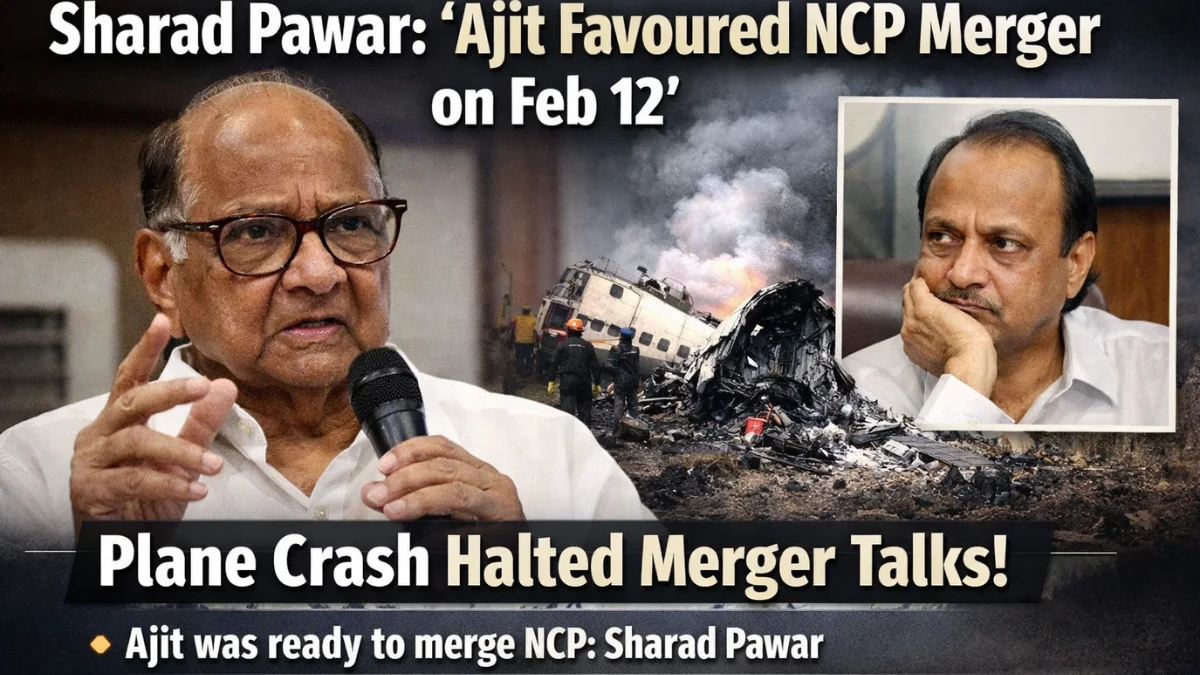
The political landscape of Maharashtra witnessed an emotional and unexpected turn when Nationalist Congress Party (NCP) founder Sharad Pawar revealed that his nephew and senior party leader Ajit Pawar had supported the merger of the two rival NCP factions and had even proposed February 12 as the tentative date for reunification. According to Sharad Pawar, these crucial discussions came to a sudden halt following a tragic plane crash that shook the state and disrupted ongoing political negotiations.
The revelation has reignited debate over the future of the NCP, the legacy of Ajit Pawar, and the missed opportunity for political reconciliation at a time when Maharashtra politics remains deeply fragmented.
This article explores the full background, political context, internal dynamics, emotional undertones, and long-term implications of Sharad Pawar’s statement.
The Nationalist Congress Party: A Brief Background
The Nationalist Congress Party was founded in 1999 under the leadership of Sharad Pawar, emerging as a powerful regional force in Maharashtra. Over the years, the party built its strength through grassroots networks, cooperative institutions, and a strong presence in rural politics. Sharad Pawar’s political experience and strategic acumen helped the NCP become a key player in coalition governments both at the state and national levels.
Ajit Pawar, Sharad Pawar’s nephew, rose through the party ranks to become one of its most influential leaders. Known for his administrative efficiency and strong hold over western Maharashtra, Ajit Pawar served multiple terms as Deputy Chief Minister and handled critical portfolios.
For decades, the Pawar family symbolized unity, continuity, and political stability within the NCP.
The NCP Split: A Turning Point
The political unity of the NCP suffered a major rupture when Ajit Pawar led a faction of party legislators away from Sharad Pawar’s leadership. This split resulted in two competing NCP groups, each claiming legitimacy, ideological continuity, and the party’s legacy.
The division weakened the party’s electoral prospects, confused its voter base, and reduced its bargaining power in Maharashtra’s complex coalition politics. The split also created emotional strain within the Pawar family and long-time party workers who had worked under a unified banner for decades.
Despite the public political rivalry, insiders consistently indicated that communication channels between the two factions were never completely shut.
Behind the Scenes: The Beginning of Merger Talks
Over time, political realities began to outweigh personal and ideological differences. The emergence of strong rival parties, changing voter expectations, and repeated electoral challenges pushed both factions to reassess their strategies.
Senior leaders from both sides quietly initiated discussions aimed at exploring a possible reunion. These talks were not rushed announcements but slow, careful negotiations involving trust-building, power-sharing arrangements, and consensus on future leadership roles.
According to Sharad Pawar, Ajit Pawar was personally invested in these discussions and believed that reunification was necessary for the long-term survival and relevance of the NCP.
February 12: A Symbolic Date for Reunification
Sharad Pawar’s revelation that Ajit Pawar had proposed February 12 as the merger date is politically significant. The date was reportedly chosen to allow adequate time for internal consultations, coordination with alliance partners, and preparation of a unified political roadmap.
More importantly, the proposed merger was not merely a formal announcement. It was intended to signal the end of internal conflict, restore party unity, and present a consolidated leadership ahead of upcoming political challenges.
Party insiders suggest that several senior leaders had already warmed up to the idea, and ground-level workers were beginning to prepare for reconciliation.
The Plane Crash That Changed Everything
Just as momentum for reunification was building, tragedy struck.
A sudden plane crash involving Ajit Pawar halted the talks entirely. The incident shocked Maharashtra’s political circles and plunged the NCP into mourning and uncertainty. What was expected to be a phase of healing turned into a moment of collective grief.
Sharad Pawar later acknowledged that the merger discussions could not continue in the immediate aftermath of such a devastating event. The focus shifted from politics to loss, condolences, and emotional recovery.
The tragedy did not just claim lives—it paused a critical political process that could have reshaped Maharashtra’s power equations.
Sharad Pawar’s Emotional Revelation
When Sharad Pawar publicly stated that Ajit Pawar had supported the merger, it was not merely a political disclosure—it carried emotional weight. His words reflected regret over unfinished discussions and a future that might have unfolded differently.
Sharad Pawar clarified that while he was not directly involved in every negotiation, he was aware of the seriousness of the talks and Ajit Pawar’s willingness to resolve differences.
The statement humanized a political rivalry that had often been viewed through a purely strategic lens.
Internal Reactions Within the NCP
Sharad Pawar’s remarks triggered mixed reactions within the party.
Support for Merger
Many senior leaders and grassroots workers believe that reunification remains essential. They argue that honoring Ajit Pawar’s intent would be the most respectful tribute to his political legacy.
Voices of Caution
Others feel that rushing into a merger without Ajit Pawar’s leadership could create new power struggles. They stress the need for patience, emotional sensitivity, and structured dialogue.
Leadership Questions
With Ajit Pawar no longer actively steering negotiations, questions have arisen about who will take charge of the reunification process and how leadership balance will be maintained.
Impact on Maharashtra Politics
The NCP plays a crucial role in Maharashtra’s coalition arithmetic. Any decision regarding merger or continued division will directly impact:
- Government stability
- Alliance negotiations
- Electoral strategies
- Policy direction
A unified NCP could significantly strengthen its negotiating power, while continued division may benefit rival parties.
Sharad Pawar’s statement has therefore shifted attention back to the NCP’s internal future at a time when Maharashtra politics remains fluid.
The Emotional Dimension of Political Unity
Beyond strategy and power, the story carries a strong emotional undercurrent. The Pawar family’s political journey has always been intertwined with the party’s identity. The possibility that reconciliation was close—but never completed—adds a sense of unfinished business.
For long-time party workers, the halted merger represents not just a political delay but a missed chance at healing old wounds.
Possible Paths Ahead for the NCP
Several scenarios may now unfold:
- Delayed Merger
Talks resume after a period of mourning, with leadership consensus built gradually. - Strategic Alliance Without Formal Merger
Both factions coordinate electorally while maintaining separate identities. - Leadership Restructuring
A new generation of leaders emerges to redefine party unity. - Continued Fragmentation
Differences persist, leading to long-term weakening of the party.
Each path carries significant consequences for Maharashtra’s political future.
A Missed Moment or a Pause?
Sharad Pawar’s statement suggests that the merger was not an abstract idea but a near reality. Whether the plane crash permanently derailed the process or merely paused it remains an open question.
Political history is often shaped by unexpected events, and this moment may become a defining chapter in the NCP’s story.
Also Read: Sunny Deol Listed as “Dharmendra Ji Ka Beta” in Border 2 Credits, Fans Get Emotional
Conclusion
Sharad Pawar’s revelation that Ajit Pawar favoured an NCP merger on February 12 before tragedy halted the talks adds depth, emotion, and complexity to Maharashtra’s political narrative.
What could have been a historic reunification became a story of interrupted dialogue and unrealized consensus. The coming months will determine whether Ajit Pawar’s vision of unity becomes a legacy fulfilled or a chapter closed too soon.
For the NCP, the challenge now is not only political strategy but emotional reconciliation—balancing respect for the past with responsibility for the future.
FAQs
Q1. Why is the NCP merger significant?
It could restore party unity, strengthen electoral performance, and reshape Maharashtra politics.
Q2. Did Ajit Pawar openly support the merger?
According to Sharad Pawar, Ajit Pawar was in favour of reunification and supported a formal merger plan.
Q3. Why was February 12 important?
It was reportedly proposed as the tentative date for the official merger announcement.
Q4. What stopped the merger talks?
A tragic plane crash involving Ajit Pawar halted all political discussions.
Q5. Can the merger still happen?
Yes, but it depends on leadership consensus, timing, and political will.

I’m a professional news publisher and passionate blogger, sharing trending stories, breaking news, and digital culture from around the world.