








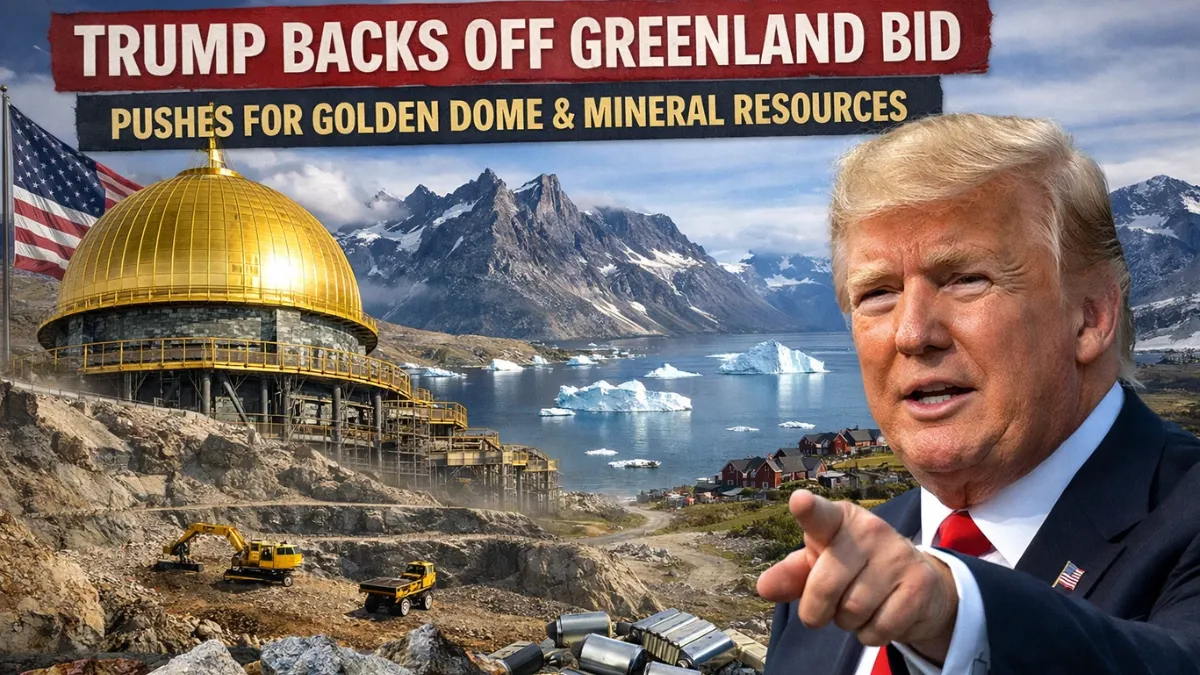
Donald Trump has once again placed Greenland at the center of global political attention—but this time with a noticeable shift in tone. After weeks of aggressive messaging and pressure tactics, Trump has dropped his latest threat connected to Greenland, calming fears of immediate economic retaliation. However, the bigger story is that he has not backed away from his long-term strategic goals.
Instead, Trump continues to push two major ambitions:
- A massive new missile-defense vision often described as the “Golden Dome”
- A renewed American drive to secure access to critical minerals, especially those needed for defense, technology, and clean-energy supply chains
This development signals a key pattern in Trump’s foreign-policy strategy: reduce short-term backlash while keeping long-term pressure and leverage alive.
In this long-form article, we’ll break down what happened, why Greenland matters so much, what “Golden Dome” means, why critical minerals are now a global obsession, and what this all could mean for the U.S., Europe, NATO, and the Arctic future.
Why Greenland Is Suddenly a Global Flashpoint Again

Greenland is not a small issue. It’s not just a remote icy landmass. It is one of the most strategically valuable pieces of territory on Earth because it sits at the crossroads of:
- North American defense
- Arctic military access routes
- future shipping lanes
- untapped mineral wealth
- global power competition
Even though Greenland is geographically closer to North America, it is politically tied to Denmark (and therefore connected to Europe and NATO structures). That makes it a unique “bridge territory” between major power blocs.
Over the last few years, the Arctic has shifted from being “cold and distant” to being:
- militarily important
- economically valuable
- politically sensitive
And Trump has made it clear that he sees Greenland as too important to ignore.
The Latest Shift: Trump Drops the Threat (But Not the Agenda)
The big headline is that Trump has pulled back from an aggressive threat related to Greenland, which had alarmed European partners and raised fears of trade retaliation and diplomatic escalation.
What this “threat” represented
The threat was widely understood as part of Trump’s strategy to apply maximum pressure—using economic tools to force cooperation, speed up negotiations, or reshape the discussion around Greenland’s future.
Why he backed down now
There are several likely reasons:
- European backlash was growing
- NATO unity was being strained
- Global markets don’t like unpredictable trade conflict
- Trump wanted to appear like a deal-maker rather than a destabilizer
- He may have received a diplomatic “framework” that lets him claim progress
This is a familiar Trump pattern:
start with a hard threat → force attention → then soften publicly → continue negotiating from a strong position.
Greenland’s Status: Not “For Sale,” Not “Up for Grabs”
Even with Trump’s shift, one reality remains unchanged:
Greenland is not American territory.
Greenland is an autonomous territory within the Kingdom of Denmark, with its own local government and growing push for stronger independence.
Greenland’s leaders have repeatedly signaled that the island’s future must be decided by Greenlanders—not by Washington, not by Copenhagen, and not by foreign pressure.
This is where the issue becomes delicate.
Because Trump’s language—especially when it suggests U.S. ownership, control, or “taking” Greenland—creates diplomatic shockwaves.
Even if Trump is now reducing the pressure publicly, the underlying question remains:
Is the U.S. trying to secure Greenland through partnership—or through leverage and control?
Why Trump Keeps Targeting Greenland: The Real Strategic Reasons

Trump’s Greenland obsession isn’t just about headlines. It’s rooted in three major strategic advantages Greenland offers:
1) Military positioning in the Arctic
Greenland sits in a location that is extremely valuable for:
- tracking missile activity
- monitoring airspace
- detecting threats early
- controlling access across the North Atlantic
If the U.S. wants to dominate Arctic security, Greenland becomes a critical platform.
2) The Arctic is opening up
Climate change is making Arctic routes more navigable. That means:
- new shipping lanes
- more competition
- more military patrols
- more economic interest
This increases the island’s value dramatically.
3) Greenland’s mineral potential
Greenland is believed to have deposits of minerals that the modern world is desperate to control.
And that leads directly to the second half of Trump’s agenda.
The “Golden Dome” Vision: A New Age Missile Shield
One of the most important parts of Trump’s ongoing push is the concept often referred to as the “Golden Dome.”
What is “Golden Dome” supposed to be?
While details vary depending on political messaging, the concept points to a large-scale missile defense plan that aims to protect the United States from threats such as:
- long-range ballistic missiles
- hypersonic missiles
- advanced cruise missiles
- potentially even space-based threats in the future
It’s often compared in spirit to the idea of a next-generation strategic defense shield—bigger, broader, and more technologically ambitious than traditional systems.
Why Greenland matters to Golden Dome
Greenland’s geography gives it massive strategic value for:
- early-warning radar placement
- missile tracking
- space and satellite coordination support
- Arctic monitoring operations
In simple terms:
If you want to defend North America from Arctic-based missile paths, Greenland is one of the best “front-row seats” on Earth.
Why Missile Defense Is Back in the Spotlight
Missile defense is returning as a top global priority because of changing threats:
The rise of hypersonic weapons
Hypersonic missiles are harder to detect and intercept because they can:
- move extremely fast
- maneuver mid-flight
- reduce reaction time
Growing competition with Russia and China
Both Russia and China have invested heavily in:
- missile modernization
- submarine capabilities
- Arctic access
- long-range deterrence systems
The U.S. response is increasingly about building layered defense systems—and Trump’s Golden Dome concept fits into that mindset.
The Critical Minerals Ambition: The Real Economic War
The third major reason Trump continues pushing Greenland is critical minerals.
These minerals are the building blocks of modern power.
Without them, you don’t have:
- advanced military weapons
- fighter jets and radar systems
- drones and satellites
- electric vehicles
- wind turbines
- batteries
- semiconductors
- smartphones
- modern manufacturing
What are “critical minerals”?
Critical minerals include materials like:
- rare earth elements
- lithium
- cobalt
- nickel
- graphite
- copper
- manganese
Some are used for energy and electronics. Others are essential for defense-grade components.
Why they matter politically
Critical minerals are not just “resources.”
They are leverage.
Countries that control the supply chain can influence:
- pricing
- industrial growth
- national security readiness
- military production capacity
That’s why the U.S. wants to reduce dependence on external supply chains and secure more reliable sources.
Why Greenland Is a Big Deal for Rare Earths and Mining
Greenland is believed to hold valuable mineral deposits that could support future mining expansion.
Even the possibility of major rare earth projects has made Greenland increasingly important in geopolitical planning.
But there are complications:
1) Harsh environment and high costs
Mining in Greenland is not easy because:
- weather conditions are extreme
- infrastructure is limited
- transportation is expensive
- skilled labor and equipment must be brought in
2) Environmental sensitivity
Greenland’s environment is fragile, and mining raises concerns about:
- water contamination
- land disruption
- long-term ecological damage
3) Local political resistance
Greenland’s local government and communities may not accept mining projects if they feel:
- outsiders benefit more than locals
- sovereignty is being undermined
- environmental risks are too high
So even if minerals exist, turning them into real supply chains is not simple.
The Bigger Strategy: Trump Wants Security + Resources + Control
When you combine all the pieces, Trump’s strategy becomes clearer:
Greenland is valuable because it offers:
- Defense positioning (Golden Dome and Arctic monitoring)
- Resource potential (critical minerals and rare earths)
- Geopolitical leverage (Arctic dominance vs rivals)
Even if Trump drops a specific threat today, he is still building toward a long-term objective:
Make Greenland central to U.S. national security and industrial independence.
NATO and Europe: Why Allies Are Nervous
Trump’s Greenland push creates anxiety in Europe for several reasons:
1) Denmark is a NATO ally
Pressuring Denmark publicly can strain alliance unity.
2) Sovereignty concerns
Europe sees Greenland as part of the Danish realm. Any hint of coercion becomes politically explosive.
3) Fear of trade weaponization
When Trump uses tariffs or economic threats, European leaders worry that:
- any disagreement could trigger punishment
- cooperation becomes conditional
- diplomacy becomes unstable
Even when Trump steps back, the fear remains that the tactic could return.
Greenland’s Own Future: Independence, Partnership, or Pressure?
Greenland is not just a passive chessboard. It has its own goals.
Many Greenlanders want:
- stronger autonomy
- greater economic independence
- more control over natural resources
- less dependence on Denmark
But Greenland also faces a reality:
Developing the economy requires partnerships, investment, and infrastructure.
That opens the door for major powers to compete for influence—especially:
- the United States
- European partners
- China-linked commercial interest (historically)
- global mining investors
The challenge for Greenland is choosing partnerships without losing control.
The Arctic Race Is Not Slowing Down
This is not a short-term news story. It’s part of a global trend.
The Arctic is becoming:
- more accessible
- more valuable
- more contested
In the coming years, we will likely see more tension around:
- military patrols
- radar installations
- shipping route control
- resource exploration
- environmental disputes
Trump’s Greenland strategy fits into this wider “Arctic race,” where geography becomes power.
What Happens Next?
Trump dropping a threat doesn’t end the Greenland issue—it simply changes the method.
Likely next moves include:
- behind-the-scenes negotiations with allies
- increased U.S. investment proposals
- security agreements framed as “mutual defense”
- stronger mineral cooperation deals
- more public messaging about “national security necessity”
What could stop Trump’s ambitions?
Major obstacles include:
- Greenland’s local political resistance
- Denmark’s sovereignty position
- NATO alliance sensitivities
- environmental opposition
- the economic reality of Arctic mining
So the future will depend on whether Trump can convert bold messaging into practical agreements that others accept.
Also Read : Sunita Williams Retires from NASA After Historic 608 Days in Space, Currently on India Tour
Conclusion
Trump may have dropped his latest threat connected to Greenland, but he has not abandoned the larger mission. His long-term vision remains clear: use Greenland as a strategic cornerstone for America’s future defense and industrial security.
The “Golden Dome” concept represents Trump’s push for a powerful next-generation missile defense posture, and Greenland’s location makes it extremely attractive for early-warning and Arctic defense planning. At the same time, critical minerals ambitions show that the new global competition isn’t just about weapons—it’s also about resources, supply chains, and economic power.
Greenland is now more than a frozen island. It is a symbol of the new world order where security, technology, and minerals are deeply connected.
The question is no longer whether Greenland matters.
The real question is:
Who will shape Greenland’s future—and on what terms?
FAQs
1) Why is Trump so focused on Greenland?
Because Greenland offers major strategic value for U.S. defense, Arctic control, and access to critical minerals needed for modern technology and military systems.
2) Did Trump stop trying to take Greenland?
He dropped a specific threat and softened immediate pressure, but he still appears committed to long-term influence through defense and mineral ambitions.
3) What is the “Golden Dome”?
It refers to a large missile-defense concept aimed at improving U.S. protection from advanced threats, including long-range and hypersonic missiles.
4) Why are critical minerals important?
They are essential for defense systems, electronics, batteries, clean energy, and modern manufacturing. Control of these minerals equals economic and security power.
5) Can Greenland legally become part of the U.S.?
That would be extremely complex and politically explosive. Greenland has its own government, Denmark has sovereignty, and any change would require massive political consent and legal steps.
6) Is Greenland rich in rare earth minerals?
Greenland is believed to have mineral potential, but extracting and building supply chains is difficult due to environment, cost, and political concerns.

I’m a professional news publisher and passionate blogger, sharing trending stories, breaking news, and digital culture from around the world.