







A Strategic, Economic, and Geopolitical Breakthrough Reshaping Indo-Pacific Trade
New Delhi / Wellington — Today
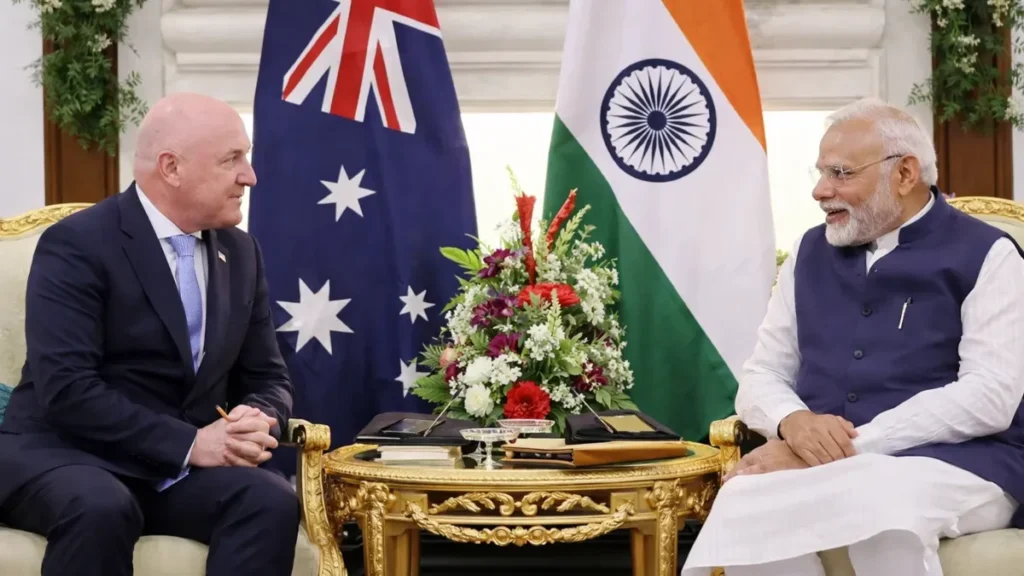
India and New Zealand have announced the conclusion of a landmark Free Trade Agreement (FTA), marking a historic turning point in bilateral relations and economic diplomacy. The breakthrough was confirmed following high-level talks between Prime Minister Narendra Modi and New Zealand Prime Minister Christopher Luxon, underscoring strong political will on both sides to elevate trade, investment, and strategic cooperation to an entirely new level.
The agreement, finalized after months of accelerated negotiations, reflects a shared ambition to deepen economic integration, diversify trade partnerships, and respond proactively to shifting global trade realities. For India, the deal aligns with its broader strategy of expanding export markets and strengthening its position in the Indo-Pacific. For New Zealand, it opens direct access to one of the world’s fastest-growing major economies.
This Free Trade Agreement is not merely a commercial arrangement. It is a strategic partnership rooted in mutual trust, democratic values, and long-term economic vision.
The Big Announcement: What the FTA Means
The India–New Zealand Free Trade Agreement is comprehensive, forward-looking, and designed to unlock untapped potential on both sides.
Core Features of the Agreement
- Zero-duty access for Indian exports entering the New Zealand market
- Major tariff elimination and reductions for New Zealand exports to India
- A clear objective to double bilateral trade within five years
- Enhanced cooperation in services, investment, innovation, and mobility
- Strong safeguards for sensitive domestic sectors
The deal ensures that economic benefits are balanced with national interests, allowing both countries to protect critical industries while expanding global competitiveness.
PM Modi–PM Luxon Talks: Political Will at the Highest Level
The announcement followed a direct conversation between Prime Minister Narendra Modi and Prime Minister Christopher Luxon. Both leaders described the agreement as historic and transformative, emphasizing that it represents a new chapter in India–New Zealand relations.
Prime Minister Modi highlighted that the FTA would act as a catalyst for:
- Trade expansion
- MSME growth
- Job creation
- Innovation-driven cooperation
Prime Minister Luxon stressed that the agreement reflects New Zealand’s commitment to strengthening ties with dynamic Asian economies and ensuring long-term prosperity through diversified trade partnerships.
The talks reaffirmed shared values such as democracy, rule of law, and open markets, reinforcing trust beyond economics.
Why This Deal Matters Now
Global Trade in Transition
The agreement comes at a time when global trade is undergoing profound transformation:
- Supply chains are being reorganized
- Protectionism is rising in several major economies
- Countries are seeking reliable, like-minded partners
Against this backdrop, the India–New Zealand FTA represents a stability-driven, growth-oriented response to uncertainty.
Strategic Indo-Pacific Importance
The deal strengthens economic architecture in the Indo-Pacific, a region increasingly central to global growth and geopolitics. It positions India as a key economic anchor and New Zealand as a proactive regional partner.
Economic Reality: Current Trade and Future Potential
Present Scenario
Despite warm diplomatic relations, bilateral trade between India and New Zealand has historically remained modest relative to potential. Both sides acknowledged that existing trade volumes did not reflect:
- Market size
- Complementary strengths
- Growing people-to-people ties
Post-FTA Growth Outlook
With tariffs reduced or eliminated:
- Indian exporters gain easier access to a high-value market
- New Zealand exporters enter a vast consumer base
- Trade volumes are expected to rise sharply
Economists project that sustained implementation could push bilateral trade into a multi-billion-dollar trajectory well before the end of the decade.
Sector-Wise Impact Analysis
1. Indian MSMEs: A Major Winner
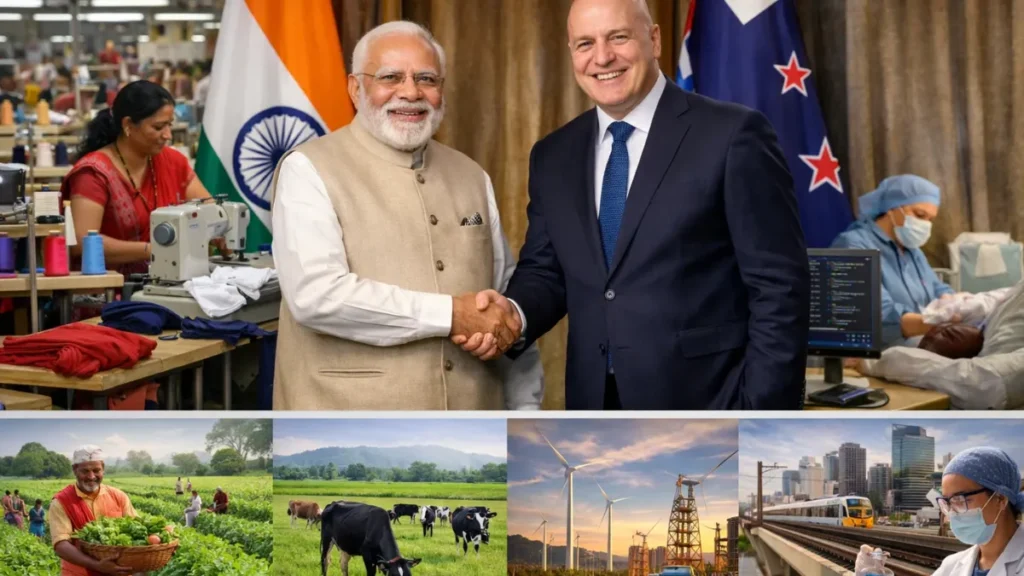
Small and medium enterprises stand to gain significantly due to:
- Reduced export costs
- Simplified market entry
- Expanded demand for Indian goods
Sectors likely to benefit include:
- Textiles and garments
- Engineering goods
- Pharmaceuticals
- Processed foods
- Marine products
The agreement strengthens India’s manufacturing and export ecosystem, especially under the “Make in India” framework.
2. Services and Skilled Professionals
The FTA enhances cooperation in:
- Information technology
- Healthcare
- Education
- Professional services
Provisions related to mobility and skill recognition are expected to create new opportunities for Indian professionals and students, while supporting New Zealand’s workforce needs.
3. Agriculture and Primary Products
New Zealand’s strengths in agriculture, horticulture, and natural products gain improved access to Indian markets, while India has protected its sensitive agricultural sectors through calibrated tariff commitments.
This balance ensures:
- Farmer protection
- Consumer choice
- Long-term sustainability
4. Investment and Innovation
New Zealand has expressed strong interest in long-term investment in:
- Infrastructure
- Renewable energy
- Agri-technology
- Research and development
India, in turn, offers scale, talent, and innovation capacity.
Safeguards and National Interests
Unlike traditional one-sided trade deals, this agreement incorporates:
- Gradual tariff phase-outs
- Exclusion of ultra-sensitive items
- Review mechanisms
These measures ensure domestic industries are not exposed to sudden shocks and have time to adapt and compete.
Political and Public Reactions
In India
- Industry bodies welcomed the agreement as growth-oriented
- Exporters called it a gateway to the Pacific region
- Policy experts praised the balance between openness and protection
In New Zealand
- Export sectors reacted positively to new market access
- Political discussions focused on ensuring fair implementation
- Business communities emphasized long-term strategic value
Overall sentiment in both countries is cautiously optimistic, grounded in realism rather than hype.
Geopolitical Significance Beyond Trade
The India–New Zealand FTA also carries strategic weight:
- Reinforces democratic partnerships
- Reduces over-dependence on limited trade partners
- Strengthens regional resilience
It complements India’s broader engagement with global trade partners and New Zealand’s Indo-Pacific strategy.
Challenges Ahead
While the agreement is ambitious, successful outcomes will depend on:
- Effective implementation
- Regulatory coordination
- Industry readiness
- Continuous political engagement
Trade agreements deliver results not on paper, but through execution.
What Comes Next
Formal Signing and Ratification
- Legal review processes will follow
- Parliamentary approvals are expected
- Formal signing is anticipated in the next phase
Implementation Framework
- Joint committees will oversee rollout
- Sector-specific roadmaps will be developed
- Dispute resolution mechanisms will be activated
Long-Term Vision
Beyond trade, the agreement sets the stage for:
- Educational exchanges
- Cultural connectivity
- Technology collaboration
- Climate and sustainability cooperation
It transforms the relationship from transactional to transformational.
Also Read: Putin Signals Unprecedented Escalation After Ukraine Targets Russia’s ‘Shadow Fleet’ Near Libya
Conclusion: A Defining Moment in Bilateral Relations
The India–New Zealand Free Trade Agreement stands as a defining moment in modern economic diplomacy. Anchored by leadership-level trust between Prime Minister Narendra Modi and Prime Minister Christopher Luxon, the deal reflects confidence, clarity, and strategic foresight.
In an era of uncertainty, this agreement sends a powerful signal: open economies, balanced partnerships, and mutual respect remain the strongest foundations for shared prosperity.
As implementation unfolds, the success of this FTA will be measured not just in trade numbers, but in jobs created, innovation fostered, and partnerships strengthened — making it one of the most consequential economic agreements in recent years.
FAQs: India–New Zealand Free Trade Agreement
1. What is the India–New Zealand Free Trade Agreement?
The India–New Zealand Free Trade Agreement is a comprehensive trade pact aimed at reducing or eliminating tariffs, improving market access, and strengthening economic cooperation between the two countries. It covers goods, services, investment, and long-term strategic collaboration.
2. Why is this agreement considered “landmark”?
The agreement is considered landmark because it significantly upgrades bilateral relations, removes major trade barriers, and sets a clear target to double trade within five years. It also reflects strong political commitment at the highest level and aligns with changing global trade dynamics.
3. How will India benefit from this FTA?
India will benefit through zero-duty access for its exports to New Zealand, increased opportunities for MSMEs, growth in services trade, and expanded avenues for skilled professionals. The deal also supports India’s export diversification and manufacturing ambitions.
4. How will New Zealand benefit from the agreement?
New Zealand gains improved access to one of the world’s largest and fastest-growing markets. Its exporters, particularly in agriculture and high-value goods, are expected to benefit from reduced tariffs, while investors gain long-term opportunities in India’s expanding economy.
5. Will sensitive sectors be protected under the FTA?
Yes. Both countries have safeguarded sensitive domestic sectors through phased tariff reductions, exclusions, and review mechanisms. This ensures that local industries and farmers are protected while allowing gradual market opening.
6. Does the agreement include services and professional mobility?
Yes. The FTA goes beyond goods trade and includes provisions to enhance cooperation in services such as IT, healthcare, education, and professional services, along with improved mobility frameworks for skilled workers and students.

I’m a professional news publisher and passionate blogger, sharing trending stories, breaking news, and digital culture from around the world.