










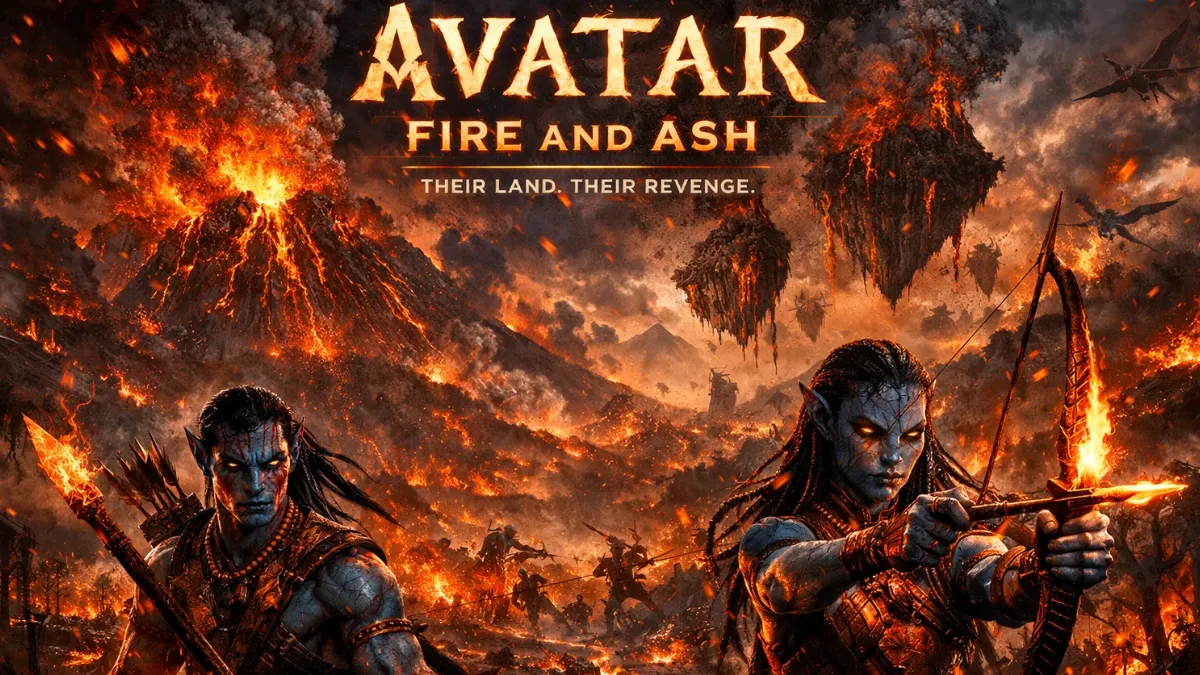
Introduction: Pandora Enters Its Most Explosive Era
Avatar: Fire And Ash-On December 19, cinema history witnessed another defining moment as James Cameron’s “Avatar: Fire and Ash” released worldwide, taking audiences back to Pandora—but this time into its darkest, most volatile chapter yet. Unlike the serene blues of oceans and forests seen earlier, this film plunges viewers into a hostile, fire-scarred Pandora, where ash rains from the sky, volcanic lands burn endlessly, and revenge fuels every conflict.

“Avatar: Fire and Ash” is not just a sequel—it is a tonal shift. Where previous Avatar films explored harmony, family, and survival, this installment dives deep into rage, betrayal, moral ambiguity, and the cost of war. Pandora is no longer only a world worth protecting—it is a world fighting itself.
With breathtaking visuals, emotionally intense storytelling, and a bold expansion of Na’vi culture, Avatar: Fire and Ash sets a new benchmark for cinematic world-building.
A Pandora Transformed: From Life to Lava
Pandora has always been alive—but now, it is angry.
In “Fire and Ash,” audiences are introduced to volcanic regions, scorched forests, rivers of molten rock, and skies choked with smoke. This is a Pandora shaped by destruction—both natural and man-made. The planet reflects the emotional state of its inhabitants: fractured, furious, and unpredictable.
The film introduces a new biome, dominated by fire and ash, where survival demands strength rather than balance. The land itself feels like an antagonist, reminding viewers that Pandora is no longer a passive victim—it reacts, resists, and retaliates.
This transformation makes the world feel more dangerous than ever before, raising the stakes far beyond previous conflicts.
The Ash People: Pandora’s Most Fearsome Na’vi Clan

One of the most talked-about elements of the film is the introduction of the Ash People—a powerful and terrifying new Na’vi clan born from volcanic regions.
Unlike the clans we’ve seen before, the Ash People:
- Reject spiritual harmony in favor of raw power
- Embrace fire as a symbol of strength and dominance
- Believe survival belongs to those who rule, not those who adapt
Their culture is shaped by loss, anger, and isolation. Where other Na’vi clans seek balance with Eywa, the Ash People challenge her authority, making them the most ideologically dangerous force on Pandora.
They are not villains in the traditional sense. Instead, they represent what happens when pain replaces faith, making them complex, ruthless, and unforgettable.
Fire, Ash, and Revenge: The Core Themes

At its heart, “Avatar: Fire and Ash” is a story about revenge—and its consequences.
1. Revenge as a Double-Edged Weapon
The film explores how revenge can give purpose but also destroy identity. Characters driven by vengeance begin to lose what they are fighting for, blurring the line between justice and cruelty.
2. The Collapse of Moral Certainty
Unlike earlier Avatar films, this installment refuses simple good-vs-evil storytelling. Every side carries guilt. Every victory comes at a cost.
3. Fire vs Nature
Fire becomes a metaphor—representing anger, progress, destruction, and rebirth. The clash between living ecosystems and uncontrolled fire reflects humanity’s own environmental struggles.
4. Legacy and Consequences
Decisions made in earlier films echo powerfully here. “Fire and Ash” reminds viewers that actions do not end—they evolve.
Jake Sully and Family: Tested Beyond Limits
Jake Sully’s journey reaches a critical turning point. No longer just a protector, Jake is forced into morally impossible choices. Leadership weighs heavier than ever as survival now demands sacrifice, compromise, and loss.
Neytiri emerges as one of the film’s emotional centers. Her rage, grief, and strength are explored with raw intensity, making her one of the most compelling characters in the Avatar saga so far.
The younger generation of the Sully family also steps forward, representing hope, rebellion, and internal conflict, showing how war reshapes identity across generations.
Humans and the New Phase of Conflict
Human presence on Pandora takes a darker turn. Rather than simple exploitation, humans now employ strategic domination, aligning with destructive forces that mirror the Ash People’s philosophy.
Technology meets fire. Control meets chaos.
The conflict no longer feels like an invasion—it feels like a planetary war, with Pandora caught between internal division and external greed.
Visual Spectacle: James Cameron Redefines Cinema Again

Visually, “Avatar: Fire and Ash” is nothing short of revolutionary.
Highlights Include:
- Volcanic landscapes rendered with terrifying realism
- Fire-based combat sequences never before seen in cinema
- Ash storms that feel suffocating and alive
- Ground-level realism combined with epic scale
James Cameron once again pushes the boundaries of motion capture, CGI, and immersive 3D, proving why Avatar remains unmatched in visual storytelling.
Every frame feels handcrafted, immersive, and emotionally charged.
Music and Sound Design: A World That Breathes and Burns
The film’s score reflects its darker tone—less lyrical, more primal. Drums, low strings, and deep choral elements dominate, echoing the raw brutality of fire and war.
Sound design plays a crucial role:
- Cracking lava
- Roaring flames
- Ash-filled silence
Together, they create a sensory experience that pulls audiences deep into Pandora’s chaos.
Direction and Storytelling: Cameron’s Boldest Chapter

“Avatar: Fire and Ash” may be James Cameron’s most daring narrative choice in the franchise. He deliberately moves away from comfort and familiarity, choosing discomfort, tension, and complexity.
The pacing is intense. The emotional beats hit hard. The story refuses easy resolutions—setting the stage for even greater consequences ahead.
This is a film that challenges its audience, not just entertains them.
Audience Reaction and Cultural Impact
Early worldwide audience reactions describe the film as:
- Darker than expected
- Emotionally intense
- Visually overwhelming
- Thought-provoking
“Fire and Ash” is already being discussed as the Empire Strikes Back moment of the Avatar franchise—the chapter where everything changes.
The film also reignites global conversations around:
- Environmental destruction
- Colonialism
- Power and resistance
- Moral responsibility
The Future of the Avatar Universe
“Avatar: Fire and Ash” clearly sets the foundation for even bigger stories ahead. Pandora is fractured. Alliances are unstable. The future is uncertain.
One thing is clear:
The Avatar saga is no longer about survival alone—it is about consequence.
Also Read: Renowned Malayalam Actor-Director Sreenivasan Dies at Age 69
Conclusion: A Fierce New Chapter Forged in Fire
With “Avatar: Fire and Ash,” James Cameron delivers a bold, uncompromising cinematic experience. This is not a comfortable return to Pandora—it is a confrontation.
Fire replaces water. Ash replaces innocence. Revenge replaces harmony.
And yet, beneath the destruction, the film asks a haunting question:
Can a world broken by fire still be healed?
“Avatar: Fire and Ash” doesn’t just expand Pandora—it redefines it, making this release one of the most powerful and unforgettable cinematic events of the decade.
FAQs
Q1. When was Avatar: Fire and Ash released?
It released worldwide on December 19.
Q2. Is the film darker than previous Avatar movies?
Yes, it explores darker themes like revenge, moral conflict, and internal division.
Q3. Who are the Ash People?
A new fire-dwelling Na’vi clan shaped by volcanic lands and a philosophy of power over balance.
Q4. Is the movie visually different from earlier Avatar films?
Yes, it introduces fire-dominated biomes, volcanic landscapes, and ash-filled skies.
Q5. Does the film set up future Avatar movies?
Absolutely. It acts as a major turning point for the entire franchise.

I’m a professional news publisher and passionate blogger, sharing trending stories, breaking news, and digital culture from around the world.